
Street Journal Multimedia Services

Author name: Street Journal

P10-M illegal drug lab busted in Caloocan

NCR

MANILA, Philippines — Police in Caloocan struck a major blow against illegal drugs early today, uncovering a large-scale clandestine laboratory and seizing chemical precursors and laboratory equipment worth over PhP10 million. The operation sends a clear message: illegal drug operations will not be tolerated. Acting Chief PNP PLTGEN Jose Melencio C. Nartatez Jr. lauded the swift response of the personnel, saying, “Muli nating pinatunayan na sa tulong ng bawat isa sa ating mga pulis, walang lugar ang ilegal na droga sa ating komunidad. To those who think they can hide behind shadows—hindi kayo ligtas sa batas.” The raid was conducted at around 8:16 AM today, January 24, 2026, in Caloocan City. Led by the Caloocan CPS, SWAT, and DDEU, the operation targeted a suspect at large for violating Section 8 of R.A. No. 9165, involving the manufacture of dangerous drugs and controlled precursors. Authorities seized two containers of liquid chemical substances believed to be phenylacetone, with a combined volume of approximately 20 liters and an estimated street value exceeding PhP10 million. Laboratory-grade glass flasks, separatory funnels, electric heating mantles, a stainless steel heating and mixing base unit, and other equipment used in drug production were also confiscated. Barangay officials and members of the media witnessed the search, and investigations are ongoing as police work to locate the suspect. Highlighting the success of the operation, PLTGEN Nartatez Jr. emphasized, “This accomplishment is a product of our Enhanced Managing Police Operations (EMPO), part of our focused agenda to bring real change on the ground. Ang ating kampanya laban sa droga ay tuloy-tuloy, at hindi tayo titigil hangga’t hindi nasusugpo ang ilegal na droga sa bawat barangay.” The PNP remains steadfast in its commitment to Bagong PNP para sa Bagong Pilipinas: Serbisyong Mabilis, Tapat at Nararamdaman, ensuring that communities are safer and citizens feel the impact of responsive and effective policing.

Zambales starts modernizing fishing capabilities with three new fishing vessels

Region 3

By Ruben A.Veloria IBA, Zambales, Philippunes – The Zambales Maritime Development Council (ZMDC), the umbrella council of all association of fishermen in the province gets three brand new motorized fishing vessels to augment the province’s fishing industry. Concurrent ZDMC Chairman, Zambales Governor Hermogenes Ebdane Jr. led in a simple ceremony for the naming of the two fishing vessels,and a maritime boat held at Philippine Coast Guard Sub-Station (CGSS) ground in Sitio Balintabog, Bgy. Amungan, Iba, Zambales. ZMDC, a province-approved people’s organization, was organized by the office of the Governor which seeks of helping its members to have a bountiful harvest, and develop the fishing industry of the province through modern equipment. According to Gov. Ebdane, two of the three boats are 45-footer fishing boats named F/V Zambales III and F/V Zambales IV, both have 125 horsepower Hyundai engine delivering a maximum speed of 18 knots. Each costs P5-Million. While the third boat was named: MB The Province of Zambales, which will be used in patroling the vicinity of the fishing ground usually visited by poachers. The body of the boats were made of one-inch fiber glass, which is stronger than the usual plyboards, and could withstand strong waves, like those of the standard deep sea fishing vessels abroad. The governor said, two more vessels are scheduled to be delivered by March 2026, which are bigger 92-footer and 100-footer fishing boats. The bigger boat will serve as “Mother fishing vessel” where all the harvested fish will be stored before going to the markets, while the smaller one will be used as hauler that collects the catch from each “payao” or artificial fish shades, then bring them to the Mother Boat. Gov. Ebdane said the purchase of the new fishing boats is one of the four projects of the Province of Zambales that are being implemented to give the fishermen a long lasting means of improved fishing methods. The other three methods are deep sea fishing, use of payao, and inland fishing, which already are taking place. Ebdane said that with the assistance of the Bureau of Fisheries and Aquatic Resources (BFAR), the Office of the Governor was able to purchase 20 units of payao and anchored them to identified fishing areas, to invite more fish to the area, as payao serves as their shades and playing areas. Meanwhile, Marlene Ong, the CEO of the Cavite-based boat manufacturer Stoneworks Specialist Int’l. Corp., described the event as “a milestone for fishing industry; a new era for the Zambales fishing industry.” Ong described the newly delivered boats as safe, fuel efficient and ideal for productive fishing, providing reliable fishing vessel. She also mentioned that the massive 100-footer fishing vessel to be delivered soon is powered by 500 HP Korean engine, with massive storage tanks and ice maker  to keep the fish fresh for weeks while in the sea. It is also equipped with sonar to locate fish even kilometers away. “These upcoming additions will further strengthen the province’s fleet and solidify Zambales as leader in modern fishing practices,” Ong said. For his part, Gov. Ebdane noted, “This is just the beginning of our modernization program.” As he urge each fishermen organization to organize thier own harvester group to improve their catch and to provide more jobs to the members.

Naga residents urged to join no-nonsense campaign for cleaner surroundings

Region 5

NAGA CITY, Philippines – The Local Government Unit of Naga is calling on communities in the city’s 27 barangays to actively participate in efforts to keep their surroundings clean to prevent prolonged flooding of streets and major roads during the rainy season. Mayor Leni Robredo stressed that community participation is crucial to the city’s campaign for a cleaner Naga, noting that the initiative is expected to result in de-clogged waterways, one of the key factors in mitigating floods. The city mayor made the statement during her program “Oras ni Mayor,” which airs every Saturday over DWIZ. According to Robredo, one of the primary causes of flooding in the city is the clogging of waterways in barangays, largely due to discarded plastic waste and other types of garbage. On the part of the city government, the mayor said that nearly a year has been spent conducting studies and analyses to determine the root causes of flooding in various parts of the city. In addition, the city continues to assess areas that have been identified as flood-prone, especially during heavy rains. She further explained that aside from encouraging residents to take part in maintaining cleanliness, the city also needs to implement measures to relocate families living near waterways to ensure that these waterways are not used as dumping areas for solid waste. “This initiative is already being undertaken through the Housing and Settlements Development Office (HSDO) to help ensure that families to be relocated will have decent shelter, while preventing garbage dumping in waterways that contributes to the flooding problem,” Robredo said. I via Jason Neola  

From Hardship to Hope: The journey of a 4Ps family from Ifugao

Lifestyle

IFUGAO, Philippines — In the heart of Lagawe, Ifugao, the Dinamling family proves that with resilience and the right support, the journey of being Pantawid Pamilyang Pilipino Program (4Ps) beneficiaries can serve to inspire others despite hardships. Living in a simple house in Barangay Abinuan, Bernardo and Juliet tilled rice as well as other crops that they sold at the local market for additional income for their family, while Bernando’s income as Punong Barangay did not suffice the needs of their family. In 2012, after meeting the criteria under the National Household Targeting System for Poverty Reduction (NHTS-PR), or commonly known as Listahanan, the family was enrolled in the 4Ps, embracing every opportunity the program offered. It was through the regular Family Development Sessions (FDS) that they learned vital skills in financial literacy at the same time strengthened their relationships and improved their knowledge on matters of health and wellness. While the program’s educational support helped keep their children in school, Juliet and Bernardo ventured into small-scale hog-raising, poultry business, corn farming and selling soft brooms to create a steady income. Their children likewise diligently tend to the pigs and chickens in their own time away from school. Meanwhile, even as 4Ps beneficiaries, the Dinamlings are also true community pillars. Bernardo is active in the Abinuan Farmers Organization and Juliet in the Abinuan Women’s Organization—working toward a better community. As an offshoot of their active involvement in the community, it allowed them to access and provide additional support and services for fellow farmers. Further, with an eye towards excelling in their education, their daughter Diana Mae is thriving in her 2nd year of college, and Daisy is a consistent honor student. The eldest sibling, Jomar, who works in the construction industry and has a family of his own already, also helps out in the family’s expenses. “Life may be hard, but with patience, determination, and faith, challenges can be overcome. Progress is possible when a family stays united and works hard,” said Juliet, remarking that she hopes to inspire other families with their journey. “Before 4Ps we were hard up in finding ways to make ends meet. Nowadays, we have peace of mind and we are empowered to take leaps of faith to build a better future for our family,” she ended. (With reports from Marjorie B. Tugguinay, SWA, MOO-Lagawe, Ifugao)

Nueva Vizcaya to boost TESDA skills program

Region 2

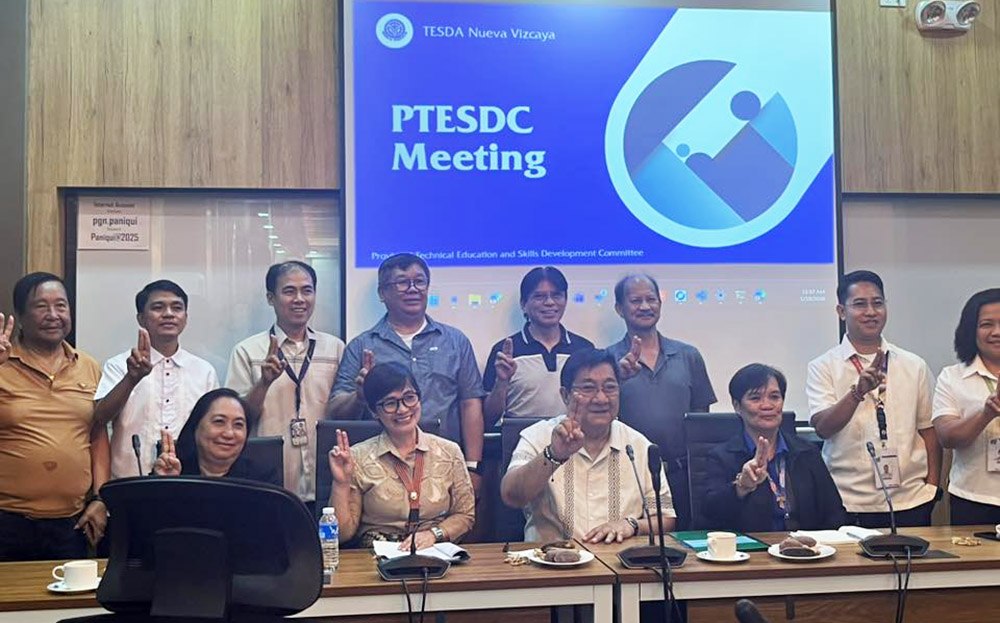
Governor eyes overseas seasonal job for residents   NUEVA VIZCAYA, Philippines — Governor Atty. Jose V. Gambito has pledged additional provincial funding to expand skills development and technical-vocational (TVET) programs in Nueva Vizcaya, with training to be implemented through the Technical Education and Skills Development Authority (TESDA). Gambito made the commitment during the first-quarter meeting of the Provincial Technical Education and Skills Development Committee (PTESDC), which he chairs. He said the additional support is intended to widen access to skills training for Novo Vizcayanos, particularly as the provincial government pursues exploratory discussions with foreign counterparts on the possible deployment of seasonal workers. The governor noted that most seasonal work programs prioritize applicants with specific competencies, making tech-voc credentials and skills certification critical for residents seeking overseas employment. Recently, officials from Jinan County in South Korea visited Gambito’s office to discuss a potential arrangement for sending seasonal workers. He is also set to meet next week with officials from Gimcheon City in North Gyeongsang Province, also in South Korea, for similar talks. Gambito is likewise expected to attend next month a Chinese New Year celebration and a welcome reception for Ms. Li Xiaoyan, the newly appointed consul and head of post of the Consulate of the People’s Republic of China. During the event, the provincial government may raise the possibility of a government-to-government recruitment mechanism with China. Aside from South Korea and China, the provincial government is also looking at Japan and Switzerland as possible partner countries for government-to-government recruitment of seasonal workers. To fast-track the initiative, Gambito instructed the Provincial Employment Service Division (PESD), headed by Dolly Rose C. Minas, to prepare a supplemental Annual Investment Program (AIP) to include the allocation of additional funds for skills training and TVET courses. The PTESDC—composed of provincial stakeholders and the local TESDA office—serves as the province’s key body for aligning technical-vocational training with industry requirements, labor market demand, and employment priorities. It aims to ensure that training programs produce job-ready graduates with practical skills needed for both local opportunities and potential overseas placements, helping reduce unemployment and support economic development in Nueva Vizcaya. ( By Rachel Magday)

Pangasinan to build first-ever government-owned Bangus Breeding and Hatchery in the Philippines

Region 1

PANGASINAN, Philippines — Pangasinan is set to strengthen food security and boost the livelihood of thousands of fisherfolk with the establishment of the first provincial government-owned Bangus Breeding and Hatchery Facility in the Philippines. The milestone project was presented during a public consultation dialogue held on January 21, 2026, attended by bangus growers, fisherfolk, and stakeholders from across the province. The project is part of the Philippine Rural Development Project (PRDP) Scale-Up, with support from the World Bank and the Department of Agriculture. The facility directly addresses one of the biggest challenges in the local bangus industry, the shortage of bangus fry and larvae. Despite being the country’s top bangus producer, Pangasinan still relies heavily on imported fry, particularly from Indonesia. “Ito na po ang matagal na nating hinihintay ng mga bangus stakeholders,” said Pangasinan Provincial Agriculturist Dalisay Moya. “May hatchery na po tayo ngayon, pero nakakapag-produce lang ito ng halos 20 percent ng requirement ng buong probinsya.” She emphasized that the project has been four years in the making, involving multiple stages of planning and coordination. “Mahaba po ang naging journey ng proyektong ito, pero maganda ang naging resulta. Ang araw na ito ay malinaw na senyales na matutuloy na talaga ang hatchery,” she added. Once operational, the hatchery located at the Provincial Agriculture Field Station in Barangay Arnedo, Bolinao Pangasinan is expected to produce over 100 million bangus fry and more than 48 million bangus larvae annually. “Nagpapasalamat po ang aming lokal na pamahalaan dahil dito sa bayan ng Bolinao itatayo ang bangus breeding hatchery ng probinsya. Ito po ay malaking tulong sa aming mga mangingisda at nursery operators dahil magkakaroon na tayo ng sapat na supply ng bangus fry at larvae, at mas mapapalago ang kabuhayan ng buong komunidad,” said Mr. Eulalio Ramirez, Municipal Agriculturist and representative of the Bolinao Local Government. The 238.9-million project is World Bank-assisted, with funding shared by the World Bank (80%), the national government (10%), and the provincial government (10%). Pangasinan Provincial Administrator Manuel “Manny” O Luis Jr. described the hatchery as one of the major agricultural projects of Governor Ramon V. Guico III. “Isa po ito sa mga flagship projects ni Governor Guico sa agrikultura. Layunin nitong palakasin ang produksyon, pababain ang presyo, at suportahan ang kabuhayan ng mga bangus stakeholders sa Pangasinan.” he said. He added that bangus farming is more than a livelihood. “Ang pagbabangus ay hindi lang trabaho… ito po ay isang lifestyle. Ang proyektong ito ay talagang para sa inyo, para mas mapagaan ang inyong trabaho.” Aside from production, the facility will also serve as a training and innovation hub for small-scale nursery operators, fisherfolk associations, and cooperatives. It will feature modern aquaculture infrastructure, including broodstock tanks, larval rearing tanks, algal and rotifer culture tanks, and a training hall. More than 17 municipalities including Agno, Alaminos City, Anda, Bani, Bolinao, Dasol, Sual, Binmaley, Bugallon, Labrador, Lingayen, Calasiao, San Carlos City, Mangaldan, San Fabian, Dagupan City, and Infanta will benefit, reaching over 40,000 fisherfolk and aquaculture stakeholders. The Pangasinan Bangus Breeding and Hatchery Project is the only PRDP-supported provincial hatchery in the country, further positioning Pangasinan as a national leader in aquaculture development. With construction expected to begin soon, the provincial government continues to work closely with communities to ensure alignment with local needs and sustainable outcomes, and to ensure the project’s success. (Rich Majin, Photo by: Ervin Alcantara | PIMRO)      

P1.1-B Baguio Integrated Terminal contract signed

Baguio City

BAGUIO CITY, Philippines  – Mayor Benjamin Magalong and Jaime Raphael Feliciano, Chief Business Development Officer of Megawide Construction Corporation signed the lease agreement for the Baguio City Integrated Terminal Project, the city’s first project implemented under the Private-Public Partnership (PPP) scheme, on January 21. The signing ended years of obstruction in the complex steps of the PPP process that began in 2020. PPP Center Executive Director Undersecretary Rizza Blanco-Latorre attended the event and congratulated the city for the successful project and acknowledged the amount of effort put in by both parties in the endeavor. Feliciano assured that they came up with a “very fair contract” considering the “rigorous and transparent process” they went through with both the executive and legislative branches of the city government. “We had to go through the eye of a needle. But because of that, we were able to come up with a contract that was very fair,” he said. He assured that they will fulfill all their obligations and build a “world-class intermodal terminal” like they have done in their quality PPP projects nationwide including the Parañaque Integrated Terminal Exchange (PITX) and the Clark International Airport. “Because Baguio is special to us and to most Filipinos, we promise to fulfill all obligations and more, in the times to come,” he said. “Megawide in partnership with the Baguio City Government aims to strategically build an intermodal terminal to help decongest the central business district (CBD). The goal is to offer an enhanced passenger experience by providing a first-world transport facility that can integrate multiple modes of transportation,” Megawide said. The BCIT project is one of the city’s major projects under the PPP program, to be built in Barangay Dontogan along Marcos Highway, which will serve as a passenger transfer terminal for provincial buses coming from outside Baguio to serve as a passenger transfer terminal to various modes of transportation to the city. They specifically aim to “consolidate provincial buses, UVs, modern jeepneys and taxis, offer better passenger facilities with comfortable and spacious waiting areas, provide quality facilities for transportation operators and develop an iconic structure that reflects the culture and heritage of Baguio.” The modern terminal is expected to provide travel conveniences (comfortable seats, waiting areas and boarding gates), passenger info displays/kiosks, ticket booths, customer service, baggage/luggage trolleys, food and retail offerings, free wifi, park and ride options); safety features and facilities for the disabled (24-hour safety and security system, ramps for the mentally challenged, elevators, etc., first aid provisions, breastfeeding stations for nursing mothers, standby police units and designated areas for massage services for the visually impaired); Multiple modes of transportation to various destinations (bus, UV, traditional and modern jeepneys and taxis) Other features are to the benefit of operators, in terms of lower operating costs and overhead costs (available space for minor repairs and cleaning, no need for separate ticketing facilities, no need for separate drivers’ lounge and canteen, no dead run due to the presence of a staging area, and the presence of EV charging facilities) Revenue is also seen to increase due to data-driven passenger management ensuring that transport demand matches supply. For the city government, revenue is expected to increase through rental payments, revenue share, property taxes, and businesses that generate contributions to business permits and taxes. The lease will last for 40 years, after which all project-related assets will be transferred to the city. The company has assured that city residents will be given priority employment for both construction and management. The project has an estimated cost of P1,186,000,000. – Aileen P. Refuerzo

Borongan City receives Gold Award as 2025 DRRM champion

Vis-Min

BORONGAN CITY, Eastern Samar, Philippines — The City Government of Borongan has been conferred the prestigious Gold Award after being named the 2025 Disaster Risk Reduction and Management (DRRM) Champion and Top Component City in Region VIII. The recognition was formally bestowed during the Kabaskog: Recognizing Champions in DRRM awarding ceremony, organized by the Regional Disaster Risk Reduction and Management Council (RDRRMC) VIII, held on January 20, at the Radiant Hotel and Events Place, Tacloban City. The recognition affirms Borongan City’s outstanding performance and sustained commitment to strengthening disaster preparedness, risk reduction strategies, and emergency response mechanisms, in line with national and regional DRRM frameworks. The city’s success is attributed to the exemplary guidance of Local Chief Executive Jose Ivan Dayan Agda, Acting City Mayor Emmanuel Tiu Sonco, and the City Disaster Risk Reduction and Management Office, led by Engr. Jaime Voces. This recognition stands not only as a testament to Borongan City’s accomplishments but also as a motivation to pursue higher standards of excellence in building a more resilient, adaptive, and disaster-ready community. Photo Courtesy: Jake Brandon Lorenzo Agda/FB

Solar, wind-powered modular cold storage to rise in Isabela

Business

ISABELA, Philippines — A hybrid solar- and wind-powered modular cold storage facility is set to be constructed in Barangay Napaccu Grande, Reina Mercedes, Isabela, behind the Public Market and Bagsakan Center. This project, which broke ground on January 20, marks a significant step toward modernizing the municipality’s agricultural infrastructure and providing farmers and fisherfolk with sustainable post-harvest solutions. The project, a joint initiative of the Department of Agriculture – Regional Field Office II (DA-RFO II) and the Local Government Unit of Reina Mercedes, is fully funded by the DA with a total cost of ₱12.87 million. It aims to reduce post-harvest losses, extend the shelf life of perishable commodities, and increase farmers’ income through a hybrid, energy-efficient facility powered by solar and wind energy with battery support. Mayor Ma. Lourdes Respicio-Saguban said the project reflects the municipality’s commitment to science- and technology-driven agriculture and sustainable livelihoods, noting that despite Reina Mercedes’ small land area and vulnerability to flooding, the local government continues to pursue innovations that benefit farmers and the local economy. DA Regional Director Rosemarie Aquino emphasized that the facility will gradually position Reina Mercedes as the “Reyna ng Agrikultura ng Isabela,” underscoring the importance of strengthening post-harvest facilities, linking farmers to markets, and focusing on key local commodities. She also expressed her gratitude to Governor Rodito Albano for his continued support in advancing agricultural modernization across the province. Assistant Secretary for Logistics Daniel Alfonso N. Atayde described the cold storage facility as a practical and adaptable solution, noting that its hybrid design helps preserve produce quality from farm to market. He added that the project supports broader logistics and food hub initiatives aimed at enabling local products to reach major markets across Northern Luzon and Metro Manila. The modular cold storage facility has a maximum capacity of one ton and can accommodate up to 370 crates of mixed vegetables or up to 1,000 kilograms of other commodities. Operating at temperatures ranging from 1°C to 10°C, it will offer cold storage rental services under a retail-based model. Once operational, the facility is expected to significantly reduce post-harvest losses, preserve produce freshness, improve income sustainability for farmers, traders, and market vendors, generate employment during construction and operation, and minimize reliance on conventional electricity.

Scroll to Top