

Street Journal Multimedia Services

NCR

United States, Philippines, Japan Host Inaugural Luzon Economic Corridor Investment Forum in Manila

NCR

MANILA, Philippines —The governments of the United States, the Philippines, and Japan hosted today the inaugural Luzon Economic Corridor (LEC) Investment Forum. Philippine President Ferdinand Marcos Jr., U.S. Ambassador to the Philippines Lee Lipton, U.S. Trade and Development Agency (USTDA) Deputy Director Thomas Hardy, Philippine Department of Finance Secretary Frederick Go, Philippine Department of Economy, Planning, and Development Secretary Arsenio Balisacan, and Ono Sho, Chargé d’Affaires ad interim of Japan to the Republic of the Philippines, attended. Sponsored by USTDA, the Forum brought together more than 600 investors, industry leaders, and government officials to mobilize private-sector investment and accelerate commercial partnerships in transportation, energy, digital infrastructure, and advanced manufacturing supply chains. It featured deal signings, project pitches, and discussions focused on improving connectivity, strengthening supply chains, and unlocking private investment across the Corridor. Ambassador Lipton, who led the U.S. delegation, described the Forum as an example of the Trump Administration’s strong commitment to creating new opportunities for American companies and workers as well as advancing mutual prosperity for the United States, the Philippines, and the Indo-Pacific region. “The United States is all-in on the Luzon Economic Corridor because it’s good for the Philippines and good for America,” said Ambassador Lipton. “It means more investment, stronger supply chains, and high quality jobs in both our countries.” The Forum also demonstrated growing momentum across the Corridor, with several new investments and agreements announced, including USTDA funding to advance the expansion of a key port ship repair facility at Subic Bay and to increase trusted, reliable digital connectivity by piloting AI-enhanced U.S.-made Wi-Fi access points across the Philippines. The governments of the United States and the Philippines signed the $60 million Philippines Energy Threshold Program through the Millennium Challenge Corporation to modernize governance of the country’s energy sector and address the high cost and unreliability of power, improve the environment for investment, and expand opportunities for American commercial engagement. Global interest in the Luzon Economic Corridor continues to grow. The LEC partnership – which currently includes Australia, Canada, Denmark, France, Italy, South Korea, Sweden and the United Kingdom – expanded at the Forum to include the European Union and Spain. Secretary Frederick Go thanked the EU and Spain for their support and trust, noting that the growing partnership can help advance projects that deliver concrete gains for the people. “We are working toward tangible results: better infrastructure, stronger connectivity and supply chains, more investment, more jobs, and greater opportunities for the Filipino people,” he said. Japan, the United States, and the Philippines, guided by the vision of a “Free and Open Indo-Pacific (FOIP),” have been advancing cooperation across a wide range of areas such as infrastructure, energy, digital connectivity, and supply chain resilience. “The Luzon Economic Corridor is a prime example of such cooperation, which holds significant potential to enhance connectivity and promote further economic development in the Philippines,” said Chargé d’Affaires ad interim Ono Sho. “Japan looks forward to this Investment Forum serving as a platform to connecting public- and private-sector stakeholders, creating new investment and business opportunities, and contributing to enhanced connectivity across Luzon.”
CIDG’s Oplan Pagtugis nets 77 wanted persons

NCR

MANILA, Philippines — In an intensified OPLAN PAGTUGIS- a nationwide manhunt operation, the Criminal Investigation and Detection Group (CIDG) successfully arrested 77 wanted persons and fugitives in a three-day conducted from September 7 to 9, 2026. The strategic synchronized law enforcement efforts led to a balanced sweep across the country’s major island group – in Luzon, 34 individuals were arrested, 29 in Mindanao, and 14 in Visayas. The three-day operations successfully accounted twelve (12) Regional Level Most Wanted Persons from Regions 1, 4B, 7, 11, 12, 14, and the Negros Island Region (NIR). Sixteen (16) Provincial Level MWPs were tracked down in Zamboanga del Norte, Benguet, Samar, Maguindanao del Norte, Leyte, Rizal, Manila, Negros Occidental, Nueva Ecija, Cebu, and Pampanga. Of the 77 accused, 19 of the arrested individuals face grave charges where bail was explicitly not recommended. The fugitives were captured by virtue of Warrants of Arrest for grave offenses— including Murder, Frustrated Murder, Attempted Murder, Rape, Statutory Rape, Qualified Theft, Theft, Syndicated Estafa, Estafa, Plunder, Robbery, and Carnapping. Arrests were also made for critical statutory violations, specifically Republic Act No. 9165 (Comprehensive Dangerous Drugs Act of 2002) and Republic Act No. 9262 (Anti-Violence Against Women and Their Children Act of 2004). The CIDG leadership Director highly commended the synchronized performance of all the operating field units involved in the swift round-up. He emphasized that these operations directly aid victims and grieving families in attaining the justice they deserve. The CIDG assures the public that the Unit remains steadfast in upholding the rule of law; and unrelenting in accounting, pursuing, and tracking down criminals, wanted persons, and fugitives – across the Philippines.

United States, Philippines Host Regional Workshop on Countering Weaponized Drones and CBRN Threats

NCR

Manila, Philippines —Marking the 80th anniversary of U.S.-Philippines diplomatic relations and the 75th anniversary of the Mutual Defense Treaty, the U.S. Department of State, in partnership with the Government of the Philippines, hosted a five-day Capstone Workshop and Combined Tabletop Exercise in Manila from August 24 to 28. The event brought together senior operational leaders from across the Indo-Pacific to strengthen regional defenses against the growing threat of weaponized unmanned aircraft systems (UAS) and chemical, biological, radiological, and nuclear (CBRN) materials. Hosted by the State Department’s Bureau of Arms Control and Nonproliferation (Office of Weapons of Mass Destruction Response and Planning) and the Philippines’ Anti-Terrorism Council Program Management Center, the workshop convened delegations from Australia, India, Indonesia, Malaysia, the Philippines, the United Kingdom, and Vietnam. The event marked the culmination of a regional training series, launched in 2025, addressing the convergence of two of the fastest-evolving security threats facing the region:  the proliferation of low-cost, commercially available drones, and the persistent risk of CBRN materials falling into the hands of malicious actors. Over the course of the week, participants worked through an intensive, scenario-based tabletop exercise addressing early warning and intelligence-sharing, crisis response, technical and forensic investigation, and cross-border prosecution of UAS-CBRN threats. “This workshop shows what’s possible when countries combine ingenuity, expertise, and resolve.  Together with our partners across the Indo-Pacific, we’re building the tools and the trust needed to stay ahead of tomorrow’s threats.  Collaboration like this reduces the threat of terrorists using drones to threaten our people,” said Executive Director of the Anti-Terrorism Council- Program Management Center Undersecretary Hansel M. Marantan. The workshop also featured a dedicated Technology Showcase on August 27, where leading U.S. technology companies presented counter-UAS and CBRN detection solutions directly to defense, law enforcement, and emergency-response officials from participating nations.  The showcase reflected the Trump Administration’s renewed focus on advancing American technological innovation and ensuring U.S. industry remains at the forefront of solving critical global security challenges alongside our allies and partners. This event culminates previous regional engagements held over the past year and a half and reflects the Department of State’s broader strategy of strengthening interagency and cross-border cooperation to counter emerging security threats across Southeast Asia and the Indo-Pacific.

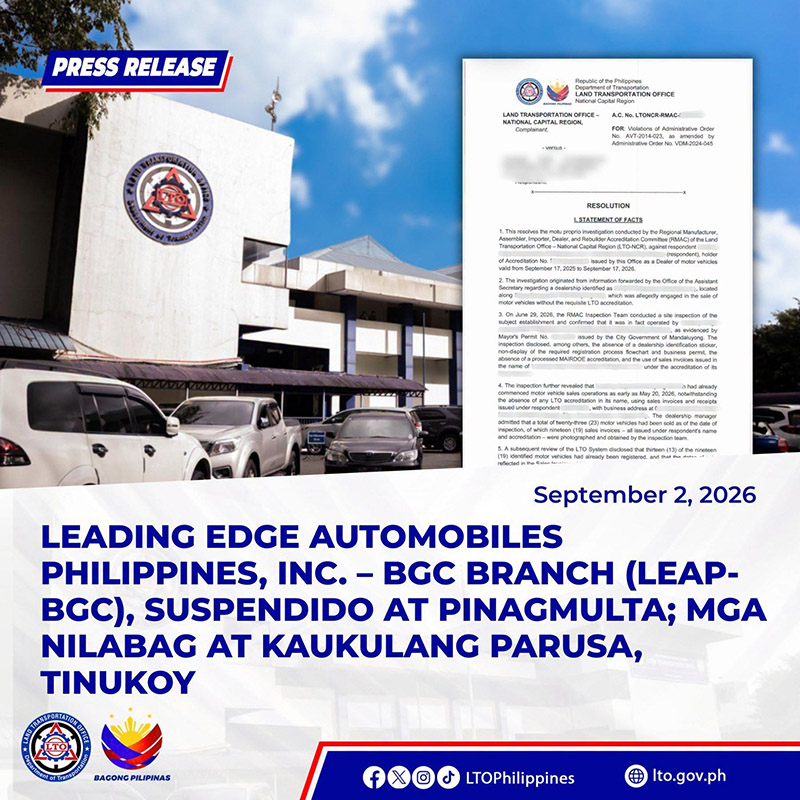
Leading Edge Automobiles Philippines,Inc., sinuspinde at pinagmulta ng LTO

NCR

Lumabas sa imbestigasyon ng Land Transportation Office (LTO) na ang Leading Edge Automobiles Philippines, Inc. – BGC Branch (“LEAP-BGC”), isang LTO-accredited motor vehicle dealer, ay nagpahintulot sa LEAP Mandaluyong Branch, na walang sariling LTO accreditation, na magbenta ng 19 na sasakyan gamit ang accreditation ng LEAP-BGC. Ang LEAP-BGC mismo ang nag-isyu ng sales invoices at nagproseso ng sales reports at registration ng nasabing 19 na sasakyan. Dahil dito, makikita sa records ng LTO na ang mga transaksyon ay ginawa sa ilalim ng accreditation ng LEAP-BGC. Natuklasan din ng LTO ang mga pagkakaiba sa petsa ng bentahan ng 13 sa 19 na sasakyan. Ang mga petsang ini-report sa LTO ay hindi tumutugma sa aktwal na petsa ng bentahan na nakasaad sa kaukulang sales invoices. Malaki ang inabot ng administrative fine na ipinataw ng LTO sa LEAP-BGC, batay sa graduated penalty schedule na nagtatakda ng P500,000.00 bawat transaksyon para sa serious offense at P100,000.00 bawat transaksyon para sa less serious offense. Kabilang sa mga paglabag ang pagpapahintulot sa unaccredited LEAP Mandaluyong Branch na magbenta ng 19 na sasakyan gamit ang accreditation ng LEAP-BGC; ang pag-isyu ng sales invoices at pagproseso ng sales reports at registration ng nasabing 19 na sasakyan; at ang maling pag-uulat ng petsa ng bentahan ng 13 sasakyan. “Hindi natin papayagan na gamitin ang mga accredited dealer bilang front para sa mga unauthorized transactions. Pare-pareho ang ating mga patakaran para sa lahat, at mananagot ang sinumang magtatangkang umiwas o lumusot sa mga ito,” pahayag ni Asec. Lacanilao. Pinaalalahanan din ng LTO Chief ang lahat ng accredited dealers na sila ang may pananagutan sa pagiging tama at makatotohanan ng lahat ng sales reports, invoices, registration documents at iba pang records na kanilang isinusumite sa ahensya. “Nakasalalay sa tama at makatotohanang records ang integridad ng ating motor vehicle registration system. Patuloy nating paiigtingin ang monitoring at enforcement upang maprotektahan ang publiko at matiyak na sumusunod ang lahat ng accredited dealers sa mga patakaran at regulasyon ng LTO,” dagdag niya.

LTO, CIDG raided counterfeit license pale manufacturing plant in Malabon

NCR

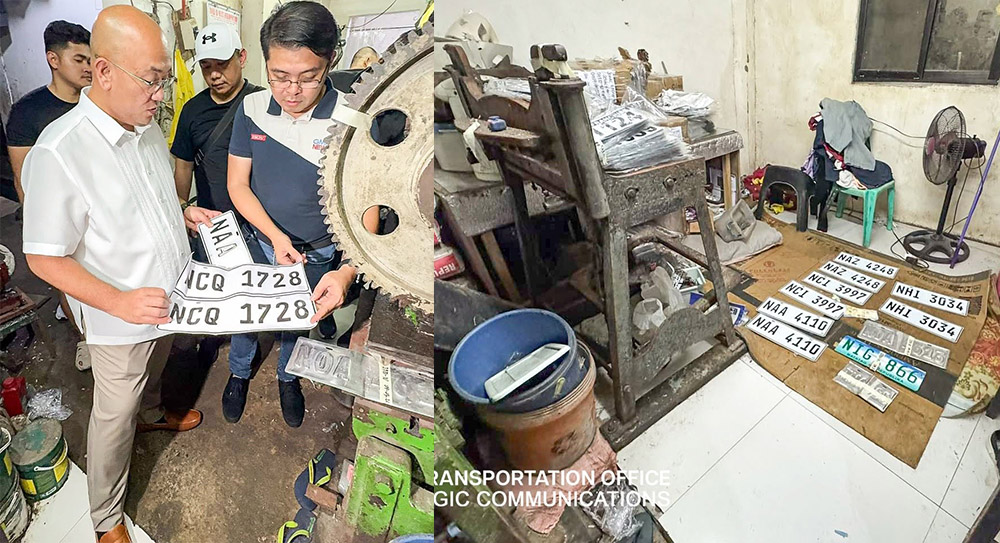
MALABON CITY, Philippines — Two individuals were arrested in an entrapment operation by the Land Transportation Office (LTO) and the Criminal Investigation and Detection Group (CIDG) against the manufacturing and sale of counterfeit LTO plates and documents in Barangay Tugatog, Malabon City on September 2, 2026. The operation was conducted as part of the strict implementation of Memorandum Circular No. MVL-2026-5314 under the leadership of LTO Chief, Assistant Secretary Markus V. Lacanilao, to ensure the use of authorized plates and suppress the manufacturing and sale of counterfeit plates and documents. The operation began after the LTO received information regarding the illegal activity which was immediately verified and subjected to investigation led by Intelligence and Investigation Division (IID) Chief, Renante G. Melitante. After confirming the information, the LTO Law Enforcement Service (LES), in collaboration with the CIDG, conducted an entrapment operation led by Police Captain Von Isaac S. Lagmay. During the actual operation, two individuals were apprehended while the transaction was in progress. Evidence included marked money worth five hundred pesos (₱500.00) and five pairs of fake license plates. Upon further investigation, it was determined that a rented space was being used as a workshop and storage for fake license plates and LTO documents before being distributed to buyers. This included fake driver’s licenses. Assistant Secretary Lacanilao personally went to the operation site to see for himself the confiscated fake license plates and the results of the operation. After the operation, the arrested persons and the confiscated evidence were brought to the CIDG-Anti-Organized Crime Unit (AOCU) office for appropriate processing. The arrested persons also underwent examination by the PNP Forensic Group before being placed in custody, while the appropriate case is being prepared against those involved based on the results of the investigation. “I will not allow the name of the LTO to be used in illegal activities. We will go after those who use, manufacture, and sell fake license plates and documents and ensure that they are held accountable,” said Asec. Lacanilao. “We will do our job, I will continuously improve the LTO system because this kind of nonsense has no place in us,” he added. Finally, the LTO encourages the public to avoid transacting with those offering fake license plates or documents and to immediately report to the agency anyone involved in illegal transactions. The LTO thanks the citizens who provide information and its partner agencies in law enforcement. The agency continues to work to hold violators accountable, because for the LTO, every violation has a corresponding liability.

SSS marks 69th anniversary with stronger member protection, expanding services

NCR

QUEZON CITY, Philippines – The Social Security System (SSS) marked its 69th Anniversary, reaffirming its commitment to protect Filipino workers and their families while strengthening the System’s financial sustainability, expanding access to social security, and transforming the delivery of services. Carrying the theme “Bawat Isa Protektado, Bawat Bukas Sigurado,” the anniversary celebrates nearly seven decades of providing social security protection while looking ahead to the evolving needs of Filipino workers and their families. During the 69th Anniversary Press Conference at the SSS Main Office in Quezon City, SSS President and Chief Executive Officer Robert Joseph M. de Claro presented the System’s latest performance and key initiatives, highlighting the continued expansion of benefits, financial assistance, retirement savings, and digital services. “For 69 years, SSS has been a steadfast partner of Filipino workers and their families, providing protection when they need it most. As we move toward our 70th year, we are focused on making that protection stronger, more accessible, and more responsive while ensuring that SSS remains financially sustainable for generations to come,” de Claro said. Finance Secretary and Social Security Commission (SSC) Chairperson Frederick D. Go underscored the importance of maintaining the SSS’ financial strength to ensure that it can sustainably provide and expand social protection to more Filipino workers and their families. “A stronger fund means a stronger capacity to pay pensions and benefits. It means greater assurance that when today’s worker retires, or when hardship strikes a member’s family, SSS will have the capacity to respond,” he said. ₱205.56 billion released in benefits From January to July 2026, SSS released a total of ₱205.56 billion in benefit payments to members, pensioners, and their beneficiaries. Retirement and death benefits accounted for the largest share of Social Security benefit payments totaling ₱180.86 billion from January to July 2026. This included ₱110.83 billion for regular pensioners and ₱43.89 billion for survivor pensioners, covering 2.70 million and 1.23 million pensioners, respectively. Pension reform strengthens retirement protection SSS continues to implement the Pension Reform Program (PRP), the first multi-year pension increase program in SSS history. Under the PRP, pensioners receive annual pension increases every September from 2025 to 2027. Retirement and disability pensioners received a 10% increase in their monthly pensions, while death and survivor pensioners received a 5% increase. For 2026, SSS has disbursed approximately ₱6 billion in additional pension benefits to help pensioners cope with inflationary pressures and higher energy costs. The pension increase was released earlier in June as part of SSS’ support for pensioners amid the national energy situation. As of July 2026, the average basic monthly pension was ₱5,704, inclusive of the additional ₱1,000 benefit for Social Security pensioners and ₱1,150 for Employees’ Compensation pensioners. Contribution collections remain strong Members’ contributions reached ₱235.33 billion from January to July 2026, continuing to provide the primary funding base for SSS’ benefit and service obligations. During the period, SSS recorded ₱268.14 billion in total revenues and ₱212.64 billion in total expenditures, resulting in ₱55.50 billion in net revenue. Operating expenses amounted to ₱7.09 billion, equivalent to 24.3% of the ₱29.22-billion charter limit, reflecting the System’s continuing efforts to maintain prudent expenditure management. ₱1.29 trillion investment portfolio SSS continues to maintain a diversified investment portfolio to support its long-term obligations and preserve the value of the pension fund. As of July 2026, the System’s total investment level stood at ₱1.29 trillion, with an annualized return on investment of 4.64%. Government securities accounted for 49% of the portfolio, followed by equities at 14%, loans to members and pensioners at 13%, real estate at 12%, and corporate notes and bonds at 8%. The remaining investments were in bank deposits, externally managed funds, and mutual funds. SSS manages its investment portfolio through prudent risk management and disciplined asset allocation to generate sustainable returns while safeguarding the pension fund. Expanding financial assistance In response to rising energy costs, inflationary pressures, and broader economic challenges, SSS has enhanced its loan programs to provide members with more accessible financial assistance during times of need. The Enhanced Emergency Loan Program (ELP), which took effect on 1 May 2026, provides qualified members with access to up to ₱20,000 at an interest rate of 7% per annum, with a six-month repayment moratorium. The program also relaxed the contribution requirement from 36 to 18 months, provided that the member has at least six posted contributions within the last 12 months. SSS has also rolled out the SSS Micro Loan Program, or SSS LoanLite, which provides qualified employed members with a fully digital option for short-term financial assistance through participating financial institutions. UnionDigital Bank is the first participating financial institution to make SSS LoanLite available through its mobile application. Representatives of the other participating financial institutions, Rizal Commercial Banking Corporation (RCBC), Land Bank of the Philippines, UnionBank of the Philippines, and Standard Economics, were also present during the SSS 69th Anniversary Press Conference, underscoring the strong partnership between SSS and its financial institution partners. The other LoanLite partners will make the facility available through their respective digital platforms as their systems become ready. Strengthening retirement savings SSS is also expanding opportunities for members to build additional retirement savings through the Mandatory Provident Fund (MPF) and Pension Booster (PB). As of July 2026, MPF contributions reached ₱263.12 billion from 9.18 million members. The PB recorded ₱2.09 billion in contributions from 95,745 members, giving members another option to build additional retirement savings. Expanding social security coverage As of July 2026, SSS had 44.25 million covered members, including employed, self-employed, voluntary, and Overseas Filipino Workers. The System also maintained 292 local offices nationwide and 30 foreign offices, allowing it to serve members in the Philippines and abroad. SSS was likewise serving more than 1 million active employers, strengthening its partnership with employers in expanding and sustaining social security coverage. Preparing for the future SSS is developing new programs designed to respond to the evolving needs of its members. Among these is the Energy Sustainability Loan Program, which will allow qualified members with Mandatory Provident Fund

Faith Leaders in PH join 3,000 Worldwide to Defend Religious Freedom, Due Process

NCR

MANILA, Philippines — Philippine pastors and other Christian delegates joined about 3,000 religious leaders worldwide in a global call to defend religious freedom, equality, human dignity and due process. The Philippine gathering brought together 374 participants through onsite and online sessions held in three locations across the country recently. The Philippine participation was part of the 1st Joint Assembly of World Pastors, organized by the Council for Christian Mutual Growth (CCMG), Korea Christian Leaders Training Institute (KCLTI), and Pastors Alliance for Life and Human Rights (PAFHLR). The global assembly was held in South Korea on August 13. Under the theme “Defending Religious Freedom and Christian Innovation,” participants called for greater cooperation across denominational lines under the banner “One Body. One Voice. One Mission. Advancing Peace Through God’s Word.” Its three central calls were “Global Fellowship,” “Defend the Truth,” and “Innovate for the Kingdom.” The global gathering drew about 3,000 religious leaders from Korea and other countries, excluding Philippine participants, with leaders from countries including Russia and Zambia. Organizers said the participation underscored that religious freedom and human dignity extend beyond any single denomination or nation. A major focus was the situation in South Korea involving the detention and trial of a 95-year-old religious leader, Chairman Lee Man-hee of Shincheonji Church of Jesus. Participants stressed that judicial decisions must rest on law, evidence and due process, rather than public pressure or religious differences. “Public opinion must never replace evidence, truth, and due process,” the joint declaration stated, warning that discrimination against one religious community can put everyone’s religious freedom at risk. Rev. Im Young-woong, senior pastor of Saehimang (New Hope) Church of the Presbyterian Church of Korea, also questioned calls to dissolve religious corporations, asking whether a standard applied to one religious organization could eventually be used against another. Bishop Elias Elijah Changa, founder and president of the Zambia-based Missionary Ambassadors for Global Evangelism, said that acknowledging Chairman Lee Man-hee’s peace-building and interfaith activities through Heavenly Culture, World Peace, Restoration of Light does not mean exemption from the law, stressing that any judgment should be based on law and evidence alone, not disagreement with his religious beliefs. Organizers also raised concerns over what they described as threats to religious freedom and the separation of church and state in South Korea, emphasizing that the issue should not be viewed as the concern of one denomination alone. For Philippine participants, the assembly affirmed a shared responsibility among Christian leaders worldwide to protect religious freedom, human dignity and due process for all, while strengthening cooperation in advancing peace.                  

BOC-NAIA condemns over 35 tons of abandoned and forfeited foods

NCR

MANILA, Philippines — The Bureau of Customs (BOC) – Ninoy Aquino International Airport conducted the condemnation and proper disposal of 340 Air Waybills (AWBs) containing over 35.6 tons of abandoned and forfeited goods with an estimated value of ₱1.45 million. The cargoes, originating from various countries, consisted of vape products, dysfunctional equipment, foodstuffs, pharmaceutical products, cosmetics, and other general merchandise. The goods were subjected to condemnation for violations of Republic Act No. 11900 and Republic Act No. 10863, among applicable customs laws and regulations. District Collector Atty. Maria Yasmin M. Obillos-Mapa emphasized that the condemnation reflects the Port of NAIA’s commitment to ensuring that abandoned and forfeited goods are disposed of in accordance with established customs procedures and applicable laws. Commissioner Ariel F. Nepomuceno underscored the importance of strengthening transparency and accountability in customs operations, particularly in the disposal of goods that have been abandoned or forfeited in favor of the government. The BOC-NAIA continues to uphold lawful, transparent, and responsible customs operations, reinforcing the Bureau’s commitment to a modern and accountable Customs administration.

Philippines leads ASEAN push for stronger space cooperation under Pres. Marcos

NCR

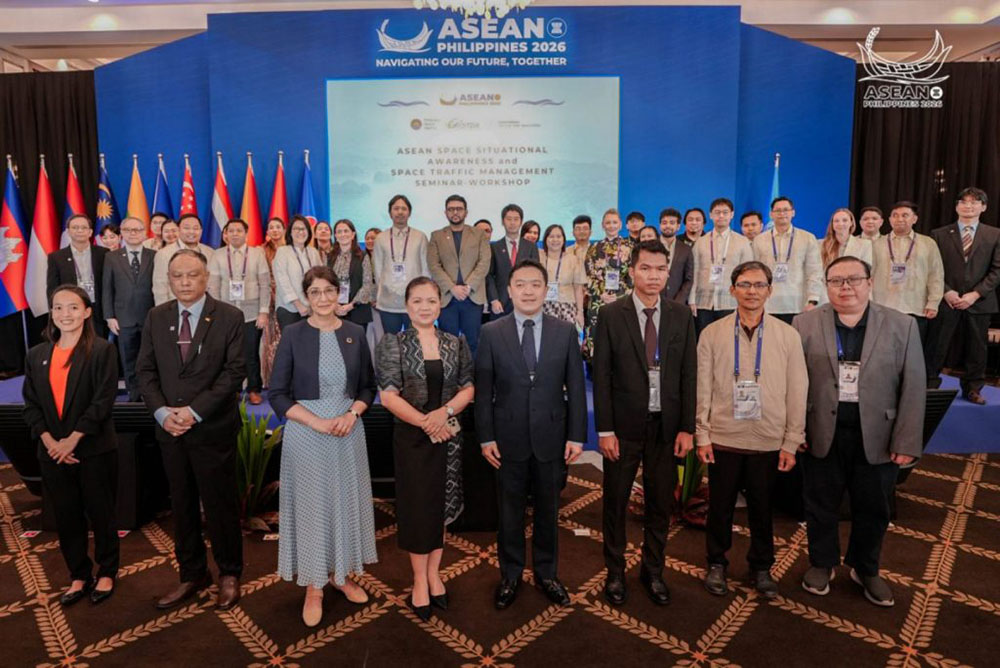
By Jerome Carlo Paunan     MANILA. Philippines — The Marcos Jr. administration is leading the Philippines’ efforts to deepen cooperation among Southeast Asian nations in space science, technology and innovation, using its 2026 chairship of the Association of Southeast Asian Nations to advance a regional framework aimed at strengthening resilience, innovation and sustainable development. The Philippine Space Agency (PhilSA) convened the ASEAN Space Forum: Navigating our Future through Space Diplomacy as part of Philippine Space Week, bringing together government officials, space agencies, international organizations, academic institutions, think tanks and other stakeholders to discuss how ASEAN can work more closely in the peaceful and responsible use of outer space. The forum supports the Marcos Jr. administration’s push for the proposed ASEAN Declaration on the Advancement of Space Science, Technology and Innovation Cooperation, or ASEAN Declaration on Space Cooperation, identified as one of the Philippines’ priority economic deliverables during its 2026 ASEAN chairship. PhilSA Acting Director General Gay Jane P. Perez said ASEAN is entering an important phase in its space development as governments, universities, industries and innovators across the region expand investments and capabilities in space science and satellite technologies. “Today, ASEAN stands at an important moment in its space journey,” Perez said. “Across our region, space capabilities are steadily expanding. More institutions are investing in research; more governments are recognizing the value of satellite technologies; and more universities, industries, and innovators are contributing new ideas and solutions,” she said. Perez said the proposed declaration is intended to provide a stronger foundation for regional collaboration. “This is why the proposed ASEAN Declaration on Space Cooperation is so important. More than a policy document, it represents a shared aspiration—a commitment to strengthen regional cooperation, promote the peaceful and sustainable uses of outer space, encourage innovation, and ensure that every ASEAN Member State can benefit from the opportunities that space offers,” she said. Trade and Industry Undersecretary Allan B. Gepty said the Philippine chairship is using the regional platform to advance more sustained cooperation in space science, technology and innovation. “Under the Philippines’ 2026 ASEAN Chairship, the proposed ASEAN Declaration on the Advancement of Space Science, Technology and Innovation Cooperation represents a significant milestone in our region’s journey toward deeper and more enduring collaboration,” Gepty said. “Its envisioned adoption by ASEAN Leaders later this year will stand as a powerful testament to ASEAN’s belief that Space Science and Technology are indispensable drivers of regional integration, economic resilience, and sustainable development,” he added. The ASEAN Space Forum provided a platform for participants to examine how space diplomacy and international partnerships can help address challenges shared by Southeast Asian countries. Discussions focused on three areas: advancing the proposed regional space declaration; using space innovation and partnerships to address challenges such as climate change, disaster risk reduction and food security; and strengthening ASEAN’s role in the evolving global space economy and governance landscape. The second session examined how space science, technology and applications could help countries respond to common challenges through stronger partnerships, capacity-building and knowledge exchange. For the Philippines, which regularly faces typhoons, flooding and other natural hazards, stronger regional cooperation in space technology could complement disaster preparedness and response efforts by providing additional data and information for risk monitoring and decision-making. Space-based applications can also support agriculture, environmental monitoring, communications and other development needs, potentially helping governments deliver services more effectively to communities. The forum’s third session examined ASEAN’s position in the global space landscape, including multilateral governance, responsible and peaceful uses of outer space and opportunities for expanded international partnerships. Panelists and moderators from government, space agencies, international organizations, think tanks, universities and other institutions took part in the discussions. The Philippines is seeking to build consensus among ASEAN member states as the region works toward the proposed declaration’s envisioned adoption by ASEAN leaders in November. The initiative also supports the Marcos Jr. administration’s broader emphasis on science, technology and innovation as tools for economic development, resilience and improved public services. Through stronger ASEAN cooperation, officials said the Philippines is seeking to help ensure that advances in space science and technology translate into practical benefits, including stronger disaster resilience, improved food security, greater economic opportunities and more sustainable development. Officials added that the forum also reinforces the Philippines’ role in shaping ASEAN’s emerging space agenda while supporting efforts to strengthen the country’s own space capabilities and space industry. (JCO/PIA-NCR)

Scroll to Top