


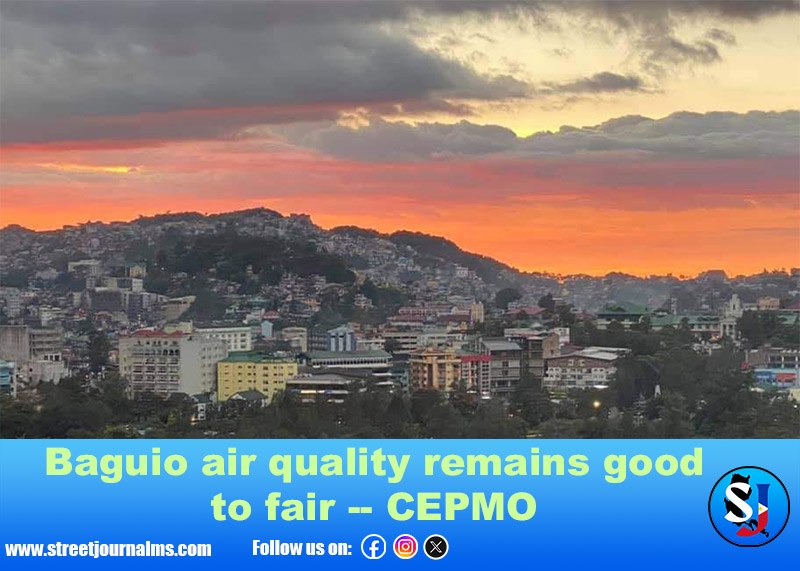
BAGUIO CITY, Philippines – The Summer Capital ambient air quality remains generally within the “good to fair” levels, according to City Environment and Parks Management Office (CEPMO).
Engr. Sofronio Pascua said this was based on the validated report of the Environment Management Bureau (EMB) of the Department of Environment and Natural Resources Cordillera (DENR-CAR).He said the city has mobile air quality sampling gadgets operated by the city government for self-monitoring purposes.One is located in front of the Baguio City Police Office (BCPO) along Upper Abanao St., which is considered one of the city’s critical monitoring sites due to the heavy volume of vehicles and the inclined road condition. The other is located at Gov. Pack Road.
Meanwhile, the EMB-CAR’s monitoring stations are located at Lake Drive in Burnham Park and at the foot of Session Road. The Lake Drive station uses a continuous ambient air quality monitoring system capable of real-time monitoring of air quality and can provide data on particulate matter (PM) 2.5 and PM 10 levels, nitrogen dioxide (NO2), sulfur dioxide (SO2), ozone (O3), and carbon monoxide (CO).
Pascua said air quality in different parts of the city at times varies from fair to unhealthy levels, especially during the dry season due to the presence of pollen, ash, construction activities, and vehicle emissions.
To help address air pollution, CEPMO continues to implement voluntary vehicle emission testing.Administrative Order No. 56, series of 2019, mandates daily voluntary emission testing from Monday to Sunday with a P100 fee payable at the City Treasury Office.
Vehicles are given two chances to pass the test, and those that fail twice must pay another testing fee for retesting. Vehicles that pass will receive a Certification of Voluntary Testing (CVT), exempting them from roadside emission testing for two months, provided they properly maintain their vehicles.
However, vehicles still found emitting excessive smoke during the grace period may still be subjected to roadside testing. Failed vehicles will have their CVT cancelled, while those issued warnings are given seven days to repair or maintain their vehicles or face automatic apprehension.
Most vehicles undergoing voluntary emission testing are public utility vehicles.
The Roadside Inspection Testing and Monitoring Team (RITMT), which has been in operation for years now, continues to conduct random roadside tests. Aside from its regulatory purpose, the RITMT also carries out information, education, and communication campaigns on clean air compliance.
He added that private smoke emission testing centers are also being monitored by a joint task force composed of the Department of Trade and Industry (DTI), Land Transportation Office (LTO), DENR, and the city government to ensure proper validation of testing centers and vehicles.
Pascua also stressed the role of the Baguio-La Trinidad-Itogon-Sablan-Tuba-Tublay (BLISTT) Airshed Governing Board in ensuring that adjacent municipalities adopt and implement complementary ordinances and strengthen enforcement efforts to improve regional air quality.( Aileen P. Refuerzo)