

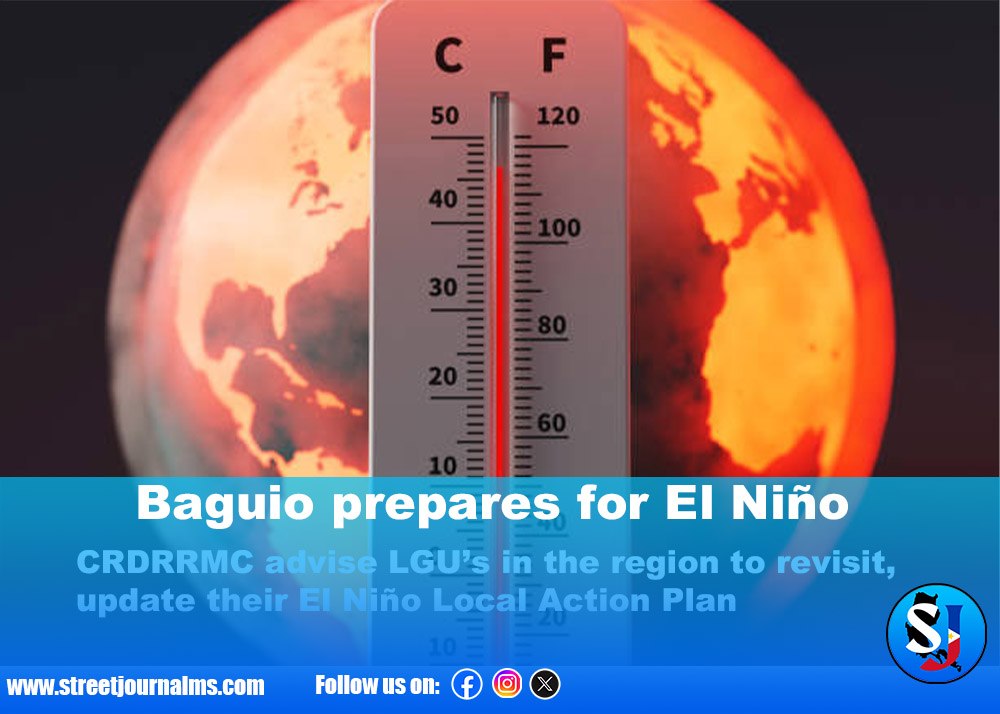
CRDRRMC advise LGU’s in the region to revisit, update their El Niño Local Action Plan
BAGUIO CITY, Philippines — The city government has begun preparing for El Niño as the country braces for a prolonged dry spell which weather experts say has the potential to develop into a severe one dubbed as “Super El Niño.”
As early as April 7, Mayor Benjamin Magalong had directed the City Disaster Risk Reduction and Management Office (CDRRMO) under Engr. Charles Bryan Carame to begin preparations for the drought.
Magalong issued the directive during the Management Committee meeting noting forecasts that the country may experience up to six months of drought conditions, with below-normal rainfall expected to start in June and potentially persist until December.
He said there is a need for early planning and coordination to mitigate the impact of water shortages, especially on communities, industries and essential services.
He also urged departments to implement water conservation measures and ensure that contingency plans are in place.
Carame said they are now working closely with other city departments and national agencies to monitor developments and carry out preparedness measures to safeguard residents against the effects of the anticipated El Niño. (Aileen P. Refuerzo)
Meanwhile, the Cordillera Regional Disaster Risk Reduction and Management Council (RDRRMC) is advising local government units in the region to revisit and update their El Niño Local Action Plan.
This, as the Philippine Atmospheric, Geophysical and Astronomical Services Administration (PAGASA) officially raised its El Niño Southern Oscillation (ENSO) Alert and Warning System to “El Niño Alert” on April 22. It cited the high likelihood of its development in the coming month and possible persistence into early 2027, which may bring drier-than-usual conditions, including dry spells and droughts in some parts of the country.
During the Pre-Disaster Risk Assessment (PDRA) meeting, Engr. Larry Esperanza of the Baguio Synoptic Station shared that conditions in the tropical Pacific remain neutral though with a 62 percent chance, El Niño is likely to emerge as early as June 2026 and may persist with an 83 percent chance through at least the end of 2026.
Esperanza also reported that though the country is under the dry season, there is still a possibility of rains due to localized thunderstorms. PAGASA also forecasted around one or two tropical cyclones to develop or enter the Philippine Area of Responsibility for the month of May.
The RDRRMC members looked into El Niño-related situational reports and preparedness measures from the different provincial and city local government units in the region through their local DRRM Councils and some preparedness/readiness updates from the council’s disaster response pillar chaired by the Department of Social Welfare and Development.
OCD-CAR Regional Director and RDRRMC Chairperson Albert Mogol, in his guidance, shared by OCD-CAR Operations Officer Stephanie Trinidad, advised LGUs to prepare for the possible impact of El Niño and to revisit and update their local action plans as earlier as possible.
The OCD provided information on the National El Niño Action Plan Framework and guidance for the updating of the regional and local action plans. It reminded the importance of preparedness measures focusing on water, food, and energy security, as well as on health and public safety. (Aileen P. Refuerzo and JDP/CCD-PIA CAR)