


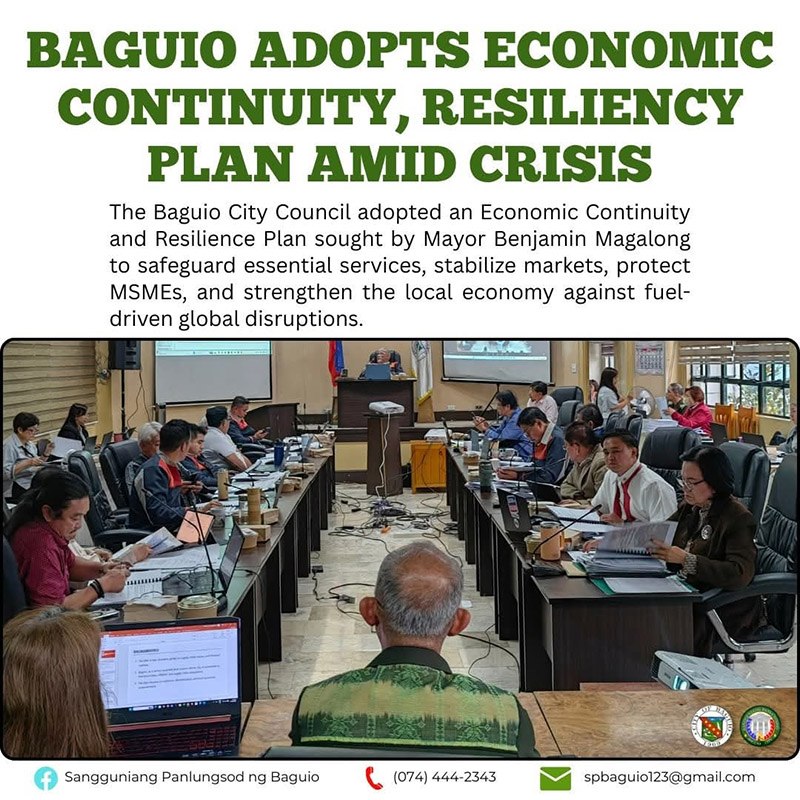
BAGUIO CITY, Philippines — The Baguio City Council approved and adopted the local Economic Continuity and Resilience Plan sought by Mayor Benjamin Magalong to ensure uninterrupted access to essential goods and services, stabilize the local market against price shocks, and protect vulnerable sectors and micro, small, and medium enterprises (MSMEs), during the regular session on April 20.
This move is a response to ongoing global crises, particularly the fuel price hike resulting from geopolitical tensions in the Middle East.
Magalong told the City Council that an economic downturn is being experienced amid national and global crises, warning that the situation may be worse than the COVID-19 pandemic.
To strengthen the city’s resilience against a possible recession, Magalong said the plan will serve as a roadmap for economic activities over the next few years.
“Before, our Gross Domestic Product at the national level was at the average of 6.0%. However, last year, the economy started experiencing a down trend. In the fourth quarter of 2025, our GDP already fell to 3.0%, with an average of 4.0% for 2025. For this year, it is expected that in the first quarter, our GDP will be below 2.0% due to weak consumer and government spending, with the downward trend expected to continue through the second and third quarters,” Magalong said.
Magalong’s statement was consistent with the presentation of the City Budget Office on the city’s projected revenue for fiscal years 2026 to 2028.
The city’s total income for FY 2026 is estimated at P3.5 billion, an increase from P2.6 billion in 2025, with local tax revenue and National Tax Allotment (NTA) having the biggest increase. However, total income is projected to decline to P3.3 billion in FY 2027 before slightly increasing to P3.4 billion in FY 2028.
City Budget Officer Atty.Leticia Clemente said, this financial projection means the city will not be able to keep up with its growing needs while also cushioning the economic impact of the ongoing fuel and energy crisis.
To remedy this, she said the executive offices are looking into the possibility of incorporating the resiliency and continuity plan into their respective budgets reviewing their projects/programs/activities (PPAs).
Through collaboration among stakeholders in the tourism industry, the transport sector, MSMEs, civil society organizations, barangays, regional line agencies, and the city government’s department heads, this plan was created to ensure Baguio City’s economic stability and resilience amid emerging global challenges and disruptions.
According to Arch. Donna Tabangin, head of the City Planning, Development, and Sustainability Office (CPDSO), Baguio City’s economy is highly service-driven, with services accounting for 71.7%.
She said the continuity and resilience plan was formulated taking into account key economic drivers such as retail and trade, finance and business services, real estate, tourism and hospitality, and education and professional services.
The plan aims to address the most probable and high-impact disruptions such as inflation and fuel price shocks, supply chain disruptions, power and water interruptions, tourism decline, financial crises, disasters, and pandemics.
Under the plan, four priority levels are identified. Priority Level 1 receives first funding, first attention, and first protection. This level covers energy and water continuity programs such as solar and backup systems for critical facilities, load prioritization, barangay-level solar energy systems, rainwater conservation and recycling systems, emergency rationing protocols, and bulk water and alternative supply sources.
Mobility/logistics (transport and fuel) and food supply stability are also under Priority Level 1. Programs under these areas include fuel prioritization, public transport subsidy, logistics system (delivery hubs), food price monitoring, rice distribution, local and regional food sourcing, and food assistance.
Priority Level 2 covers MSMEs and employment, tourism, and digital infrastructure with programs such as MSME financing plus subsidies and incentives, emergency employment program or cash-for-work, skills training, digital payments, ISP redundancy, smart monitoring systems, domestic tourism campaigns, discounts for tourism enterprises and recovery activities, even-driven economy plus circular practices, and enhancement of the Baguio website VISITA.
Financial stability and financing are classified under Priority Level 3 aimed at ensuring the local government remains financially capable of fulfilling its mandate. Programs under this level include revenue protection, cash flow forecasting, austerity measures, budget flexibility, expansion of local economic enterprises, public-private partnerships for projects, and the development of new income sources.
Priority Level 4 focuses on building long-term resilience, with particular emphasis on the circular economy, waste-to-resource initiatives, renewable energy expansion, and urban agriculture and localization.
The plan sets the following investment framework: Priority Level 1, P948.2 million; Priority Level 2, P58.1 million; Priority Level 3, P96.8 million; and Priority Level 4, P8.5 million, with a total average annual budget of P1.11 billion.
Tabangin concluded that, if the plan is successfully implemented, the city will achieve stable employment and income, continuous business operations, stable prices and supply, strong LGU revenue base, sustained economic growth, and social and economic stability. (Jordan G. Habbiling)