


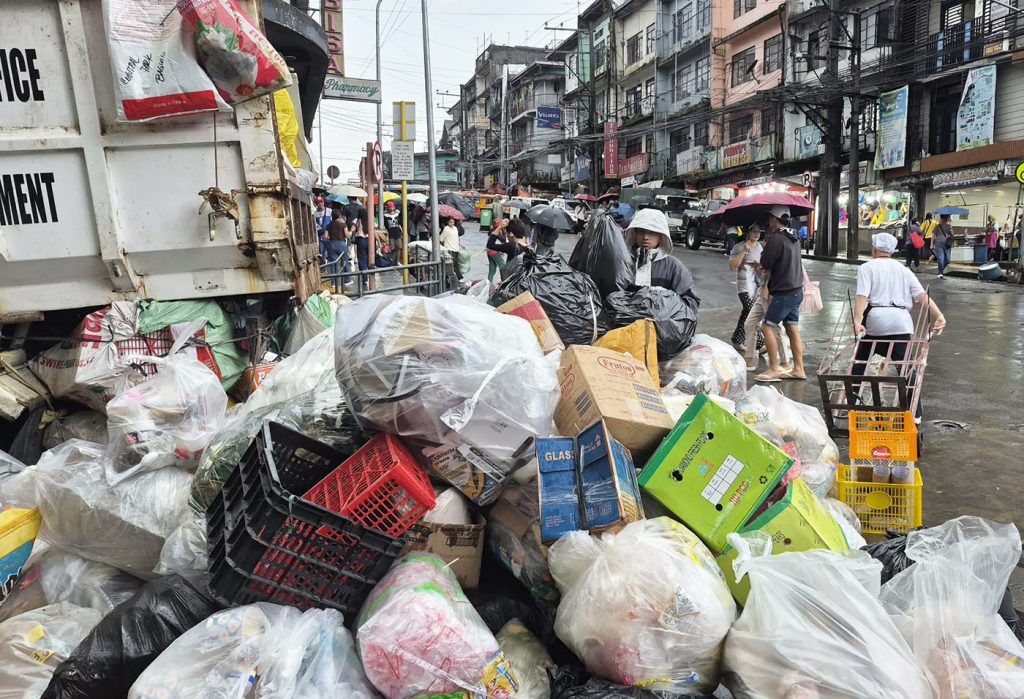
BAGUIO CITY, Philippines — The increase in garbage fees should not be taken as a reason for households, businesses and barangays to ease up on waste reduction, segregation and diversion efforts, newly installed General Services Officer Ma. Guadalupe Della said.
Della said the higher fees should instead be matched by stronger implementation of the city’s “Pansa-nopen Tayo” circular economy program particularly waste reduction, segregation, reuse, recycling and diversion.
“Reducing waste at source and increasing diversion can help lower collection and disposal costs which could help minimize the need for further garbage fee increases in the future,” Della said.
The new garbage fees took effect this September under Ordinance 69-2026 replacing the P20 monthly household fee under Tax Ordinance No. 2000-01 that had been in place for 26 years. Households served by the city’s garbage collection system now pay P75 monthly, while business fees start at P400 and vary depending on the size of the establishment, number of customers, seating capacity and other applicable classifications. Late payments carry a 25 percent surcharge.
Under the new ordinance, barangays are entitled to a 50 percent share of garbage fee collections from their constituents, with additional incentives based on collection efficiency. The share is intended to support solid waste management activities at the barangay level.
The GSO stressed that barangays should use the additional resources to strengthen their waste management programs rather than rely solely on collection and disposal services.
Residents and businesses are likewise encouraged to reduce the waste they generate and properly segregate biodegradable, recyclable and residual waste to increase diversion and lessen the volume of garbage brought to disposal facilities.
The city council enacted Ordinance 69-2026 prescribing new garbage fees for households, businesses and other waste generators last July to help finance the city’s Ten-Year Solid Waste Management Plan (2025-2034), strengthen waste reduction and recycling, and sustain garbage collection and disposal services in accordance with Republic Act 9003 or the Ecological Solid Waste Management Act of 2000.
The ordinance, principally authored by Liga ng mga Barangay President Rocky Aliping and Indigenous Peoples Mandatory Representative Maximo Edwin Jr., was approved by Mayor Benjamin Magalong and covers establishments, institutions, businesses, households served by the city collection system and other waste generators within Baguio.
It repeals Section 32 of Tax Ordinance No. 2000-01 and sets new monthly rates based on the type and size of waste-generating establishments.
Households served by the city garbage collection system will pay P75 monthly. Hospitals will pay P600 to P1,200, depending on bed capacity, while funeral parlors will pay P600 to P1,200, based on the number of chapels.
Garbage fees for lodging establishments range from P400 to P1,200, while restaurants and similar establishments, as well as bars and liquor stores, will pay P400 to P1,000, based on seating capacity. Hotels will pay P600 to P1,200.
Banks, offices, financial institutions, media stations and call centers will pay P200 to P800, based on the number of employees. Schools and other educational institutions will pay P600 to P1,200, with an additional P1 for every enrollee beyond 1,001.
Transport terminals will pay P400 to P1,200, private parking areas P400 to P1,000, auto repair shops P400 to P1,000, and department stores, bazaars and groceries P600 to P1,200.
Market stalls will pay P200 for dry goods and garden tools, P320 for fruits and vegetables, P480 for meat and fish, and P250 for other merchandise. Junk shops will pay P600, gymnasiums P600, gasoline stations and convenience stores P400 each, private parks P5 per customer, and establishments not specifically classified P200 monthly.
Businesses operating additional lines at the same location will pay a separate fee equivalent to 25 percent of the principal business’ garbage fee.
Barangay treasurers may be deputized to collect household and apartment garbage fees. Barangays will receive 50 percent of collections, with incentives raising their share to as much as 75 percent for full collection.
A 10 percent discount will be granted for annual payments made on or before April 20, while quarterly payments made on or before the 20th day of the month following each quarter will receive a 5 percent discount. Late payments will incur a 25 percent surcharge and 2 percent monthly interest.
The rates will be reviewed periodically and will automatically increase by 10 percent every three years beginning in 2027, subject to further adjustments.
The ordinance also directs the City General Services Office, in coordination with barangays, to set garbage collection schedules and prohibits residents from putting out waste outside designated collection days.
Violators will receive a warning for the first offense, a P1,500 fine for the second, and P3,000 for the third and succeeding offenses. –(Aileen P. Refuerzo)