


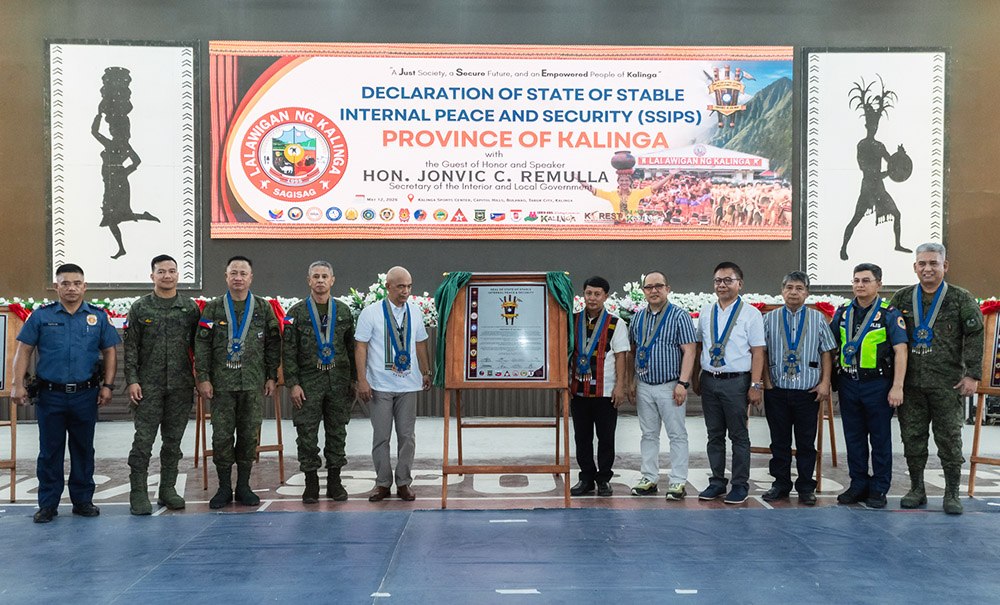
PROVINCE OF KALINGA, Philippines – The provinces of Kalinga and Apayao were formally declared as a State of Stable Internal Peace and Security (SSIPS) consecutively, marking a significant step in the province’s pursuit of lasting peace and sustainable development.
Kalinga Governor James S. Edduba, along with senior officials of the Cordillera region, police and military, led a ceremony held at the Kalinga Sports Center, Capitol Hills, Bulanao, Tabuk City, on May 12.
As part of the declaration, the primary responsibility for maintaining peace and order in the province was officially transferred from the Philippine Army (PA) to the Philippine National Police (PNP) through a ceremonial handover led by LtC. Jimrhic Obias, Commanding Officer of the 103rd Infantry Battalion, and PCol.Gilbert Fati-ig, Provincial Director of the Kalinga Police Provincial Office.
MGen.Gullver Senires, Division Commander of the 5th Infantry Division of the Philippine Army, also presented plaques of recognition for the award of the SSIPS seal to the various municipalities, the City of Tabuk, the Province of Kalinga, DILG Kalinga, and Kalinga PPO.
According to Edduba, the pledge followed by the signing ceremony symbolizes the continued unity and cooperation of stakeholders in promoting peace and development in Kalinga.
In neighboring Apayao province, Gov. Elias Bulut, Jr., said the declaration of peace shifts Apayao’s focus to jobs and long-term development.
He described Apayao’s declaration under the SSIPS as a turning point for a province that has previously suffered from armed encounters, bomb threats, checkpoints, and insurgency-related violence.
“Gone are the days of hearing about encounters, cannon fire, shelling, bombs, wounded, dead, military checkpoints. The declaration has a responsibility that now extends beyond peacekeeping, that the province must begin preparing for a unique phase of development in the years to come.”
He also urged barangay and municipal leaders and residents that the province must now position itself for investments, changes, and opportunities that will sustain the next generation.
This important activity emphasized that true and lasting peace can only be achieved through unity, cooperation, and collective action among government agencies, security forces, local leaders, and communities towards a peaceful and progressive “Bagong Pilipinas.”