


SORSOGON CITY, Sorsogon, Philippines — The Sorsogon Provincial Health Office (PHO) is calling for stronger community involvement in dengue prevention, as cases in the province reached 1,934 from January 1 to September 5.
The report includes 278 new cases reported from August 30 to September 5.
According to Jeanelita Avanica, development management officer and the Provincial Epidemiology and Surveillance Unit (PESU) focal person, this figure represents a significant increase compared to the same period last year.
Of the total cases, 992 were male, and 942 were female. The youngest patient was just two months old, while the oldest was 87 years old.
The age group of 1 to 10 years accounted for the highest number of cases, followed by those aged 11 to 20.
Sorsogon City recorded the highest number of cases at 488, followed by Bulan with 289, Irosin with 236, Castilla with 180, Matnog with 161, Donsol with 139, Pilar with 111, Gubat with 78, Sta. Magdalena with 57, Bulusan with 47, Prieto Diaz with 40, and Barcelona and Casiguran with 39 each. Juban reported 27 cases, while Magallanes had three.
However, when assessing the situation by attack rate—meaning, the number of cases relative to the population—Irosin had the highest rate, followed by Matnog and Sta. Magdalena.
Avanica said that the province has already exceeded its epidemic threshold, based on the PESU’s analysis comparing current cases to historical surveillance data.
She also reported that the number of dengue-related deaths had reached eight as of September 5, compared to four during the same period last year. More recent information provided during the interview indicated that the death toll had risen to 11 as of September 17.
Health officials identified several factors contributing to the ongoing transmission of dengue, notably the presence of mosquito breeding sites within communities.
Environmental and vector surveillance have recognized stagnant water, poorly managed waste, improper water-storage practices, and neglected areas that hold water—such as dish drainers, refrigerator drains, and uncovered containers—as potential breeding sites.
Urban and semi-urban communities are being monitored closely due to their higher population density and common water-storage practices.
Regina Gonzalgo, the development management and health education promotion officer (HEPO) designate, emphasized that preventing dengue cannot rely solely on health workers.
“Health workers cannot do it alone,” she said. “Families and communities must take responsibility for keeping their surroundings clean and eliminating potential breeding sites before mosquitoes multiply.”
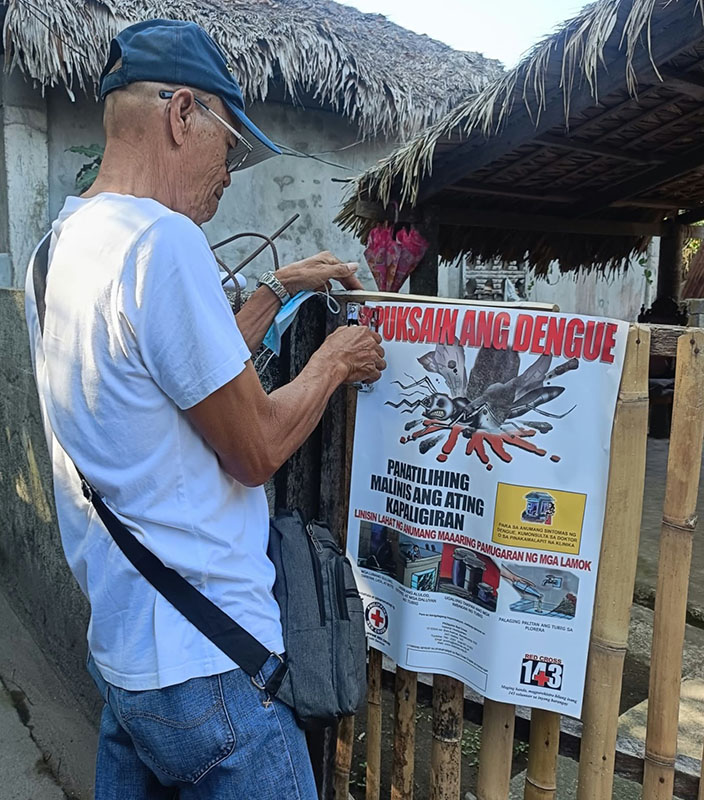
The Public Health Office (PHO) urged Sorsogon residents to practice the “4S” strategy against dengue consistently: search and destroy mosquito breeding places, practice self-protection, seek early consultation when symptoms occur, and support fogging/spraying in identified hotspots or outbreak areas.
The PHO is also promoting the 4Ts—taob, taktak, tuyo, and takip (flip, shake, dry, and cover)—which families can practice daily to prevent dengue: turn over containers that can collect water, empty accumulated water, keep surfaces dry, and cover water-storage containers.
“These measures are crucial after rainfall when stagnant water becomes breeding sites for Aedes mosquitoes,” said Gonzalgo.
Sorsogon Governor Edwin Hamor has urged local governments and communities to mobilize resources to combat the dengue threat. Forums have also been held to increase awareness about dengue prevention.
Gonzalgo and Avanica, resource speakers during the Kapihan sa PIA radio program, emphasized that the fight against dengue starts at home.
They said that while health workers can provide guidance and medical services, sustained prevention relies on every household’s action. (Mavic Aringo contributed to this report, PIA Bicol/Sorsogon)
.