


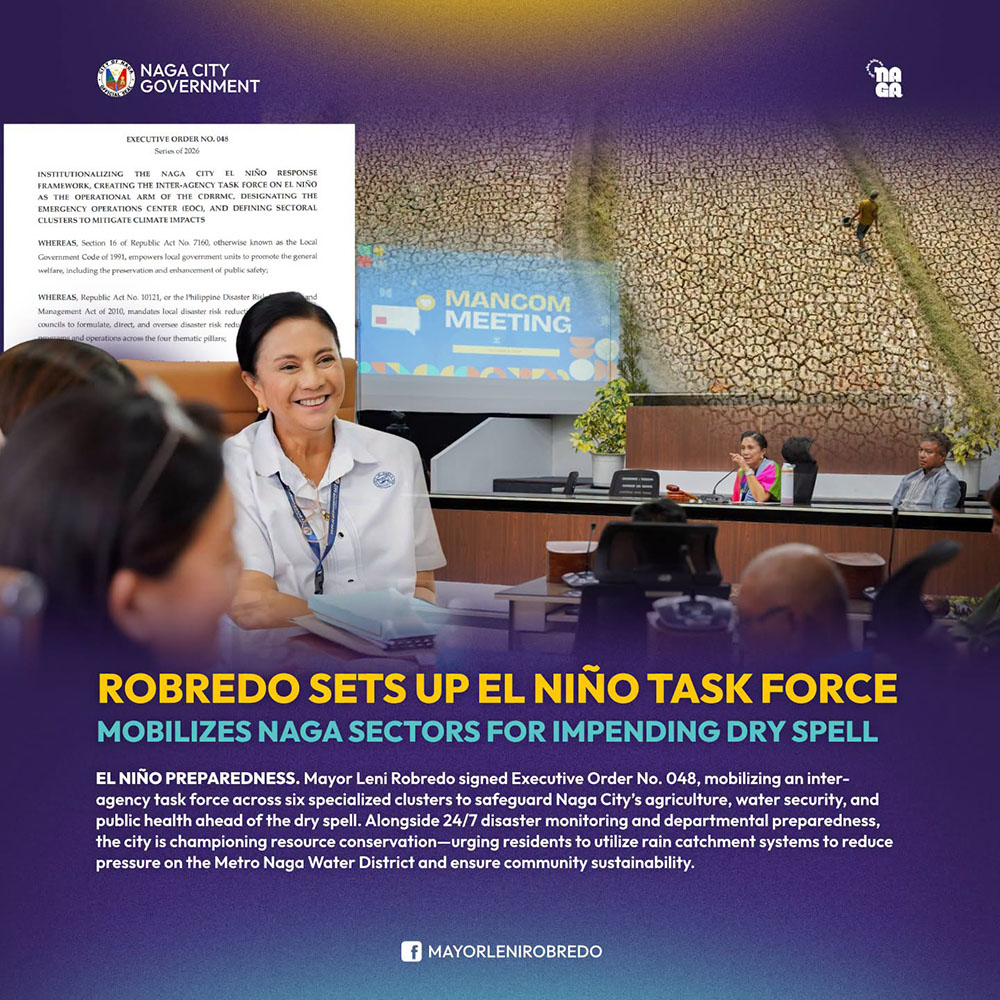
NAGA CITY, Philippines — Mobilizing local government mechanisms ahead of projected below-normal rainfall and soaring temperatures, Mayor Leni Robredo signed Executive Order No. 048 to institutionalize an El Niño response framework and inter-agency task force.
Anchored on the State of Imminent Disaster Act, the order aims to protect agriculture, water security, and public health.
“[Nagform kita nin Task Force] ang may lead ang CDRRMO, pero igwang mga assignment sa kanya-kanyang mga opisina,” Robredo said, emphasizing a coordinated multi-sectoral approach to mitigate the dry spell.
Decentralizing operations into six specialized clusters, the newly created Naga City Task Force on El Niño streamlines city interventions under the joint co-chairmanship of City Disaster Risk Reduction Management Office (CDRRMO) Officer-in-Charge Raynor A. Rodriguez and SP Committee on Disaster Risk Reduction Chairperson Allan Reiz C. Macaraig. Co-led by the Metro Naga Water District (MNWD) and the City Engineering Office, the Water Security Cluster monitors groundwater and manages water-rationing schedules.
Furthermore, the Agricultural Security Cluster distributes drought-resistant seeds and monitors prices to prevent hoarding, while the Health Cluster tracks heat-induced illnesses and pre-positions medical supplies.
Meanwhile, the Energy and Fire Safety Cluster enforces open-burning bans and secures grid stability, and the Social Protection Cluster coordinates classroom thermal adaptations and emergency employment for displaced workers.
Serving as the central 24/7 Emergency Operations Center, the CDRRMO handles real-time hazard tracking across all 27 barangays. Addressing high-intensity crises, the framework also permits deploying Incident Management Teams when necessary.
Funding draws from regular departmental budgets and the 70 percent preparedness component of the local disaster fund, while access to the 30 percent Quick Response Fund requires a formal declaration of a State of Calamity. Barangay committees are also tasked with mapping vulnerable puroks and appointing water focal persons.
To further bolster resource conservation, the city is also prioritizing household-level adaptations, such as utilizing rain catchment drums to capture and repurpose runoff for cleaning and sanitation.
As Mayor Robredo noted, integrating these practices helps ease consumer dependence on the MNWD and ensures better sustainability across communities during prolonged dry spells. | via Maida Boragay