


By Zowanna Rose Lopez
CEBU CITY, Cebu, Philippines (PIA) — One woman learned the trade surrounded by shells, and another learned it in a classroom.
Together, they represent something Cebu has quietly been building for decades — a community of craftswomen who refuse to let their heritage disappear, and who are now carrying it to an international stage.
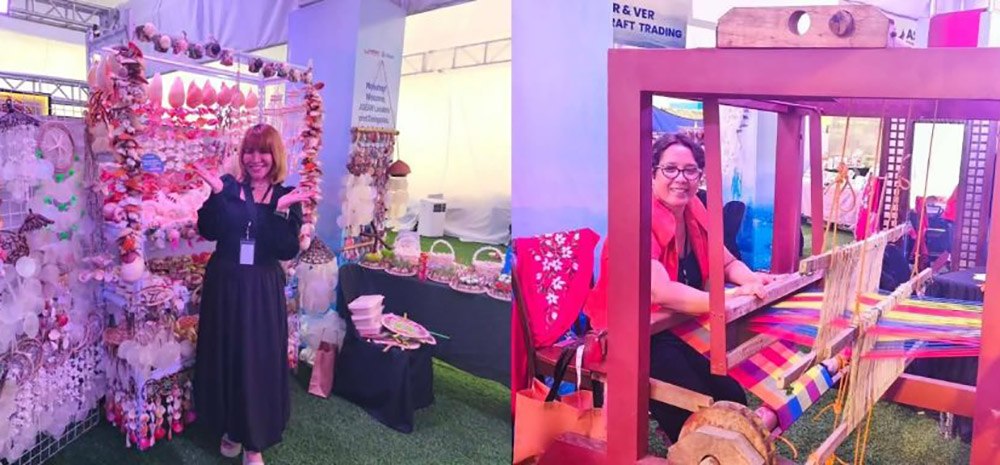
As the Philippines hosts ASEAN 2026, two Cebu-based enterprises are among those who stepped into the spotlight: Ver and Ver Handicraft Trading, a family-run shell-craft export business in Lapu-Lapu City, and Hinabalon sa Cebu, a social enterprise anchored in the handloom weaving traditions of Argao.
Different crafts, different origins — but a shared determination to show the world what Cebu makes.
DTI Cebu Provincial Director Marivic Aguilar said that is precisely the point.
“Our Cebu-made products show to our guests and delegates the talents that we have in Cebu, the products that we can manufacture. This is just a slice of what we have in Cebu — but I think this is a good slice, a profile of what we have,” she said.
Doris Dano and her husband Bayano, did not build Ver and Ver Handicraft Trading from scratch. She inherited it from a woman who simply could not stop making things.
“It’s a family business. My mother-in-law — she really loved shells. That passion, that desire to design, that’s where it all began,” Dano said.
What started as one woman’s creative obsession has grown, over 23 years, into a multi-country export operation. Ver and Ver now supplies buyers in the United States, Australia, Poland, Turkey, and Fiji, while also serving local markets — supplying resorts in Lapu-Lapu City such as Solea and BE Resort, and reaching buyers as far as Boracay.
The company does not limit itself to a single source. Shells are procured from suppliers across the Philippines and, depending on buyer specifications, from abroad.
“We don’t just source from Lapu-Lapu. We also have suppliers from around the Philippines,” Dano said.
The Department of Trade and Industry has been central to the enterprise’s growth — connecting it with international buyers, guiding design development, and facilitating participation in trade expos, including Manila FAME, which draws buyers from across Asia and beyond.
“They were one of the ones who promoted us, who pushed for us, who helped us develop our designs,” Dano said. “Dako kaayo ilang tabang namo.” (Their help was enormous.)
Revenue, she estimates, can reach into the millions of pesos. But sustaining that growth requires navigating constant pressures: rising raw material costs, particularly for abaca fiber, which has spiked sharply in price; and the growing difficulty of finding skilled young designers willing to learn the craft.
“Our older designers — they’re gone now. The new generation they don’t want to learn anymore. That is one of our biggest challenges,” she said.
Despite the headwinds, she presses on — and uses her modest online presence to encourage other small business owners facing similar walls. “Don’t stop, don’t mind what others say, just do your thing, keep going. That’s all,” Dano said.
She credited DTI for helping Ver and Ver gain visibility as a member of the One Town One Product program.
“Nagpasalamat mi sa DTI, kay tungod nila naila.” (We are grateful to DTI, because through them, we became known. They helped us greatly. Because of them, we were recognized and were able to be part of this business. They promoted us, connected us with buyers, pushed for us, helped us develop our designs, and guided us along the way.)
A final exam that became a movement
About 60 kilometers south of Cebu City, in the historic town of Argao, another enterprise took root — born not from a family workshop, but from a graduate school examination.
“This was a final exam product. It became a community extension project later on,” said Dr. Jocylyn Concepcion, a professor at Cebu Technological University-Argao Campus and project director of Hinabalon sa Cebu.
That 2014 classroom assignment has since grown into a registered social enterprise run by CTU-Argao’s College of Education, centered on the habdunan — a traditional handloom weaving machine — and on a skill that, a decade ago, was quietly dying out in Argao.
“The cultural heritage of handloom weaving in Argao was dying. We tried to revive it by introducing it to the community and to the people of Cebu,” Concepcion said.
DTI stepped in with concrete support, establishing a Shared Service Facility for Handloom Weaving at the university — providing equipment and infrastructure the enterprise could not have otherwise afforded. The partnership has held for a decade.
Hinabalon sa Cebu has since expanded its offerings beyond raw fabric. Its products now pair handweaving with hand painting — itself a craft Concepcion describes as equally at risk of disappearing.
“Hand painting is no longer a popular skill in Cebu. By weaving the two techniques together,” she said, the enterprise is preserving not one endangered tradition, but two.
Concepcion captured the weight of that responsibility plainly.
“Even a university like us — an educational institution — we can also play a role in providing socioeconomic livelihood to the last and the least of our people,” she said.
Cebu on the ASEAN stage
This year, both enterprises are part of a broader push to bring Cebu’s craftsmanship before an international audience as the Philippines hosts ASEAN 2026 and positions its micro, small, and medium enterprises for regional visibility.
Hinabalon sa Cebu has been invited to participate in the Partners Pavilion of ASEAN 2026 — an opportunity Concepcion frames as cultural diplomacy as much as commerce.
“We would like to tell the world, the ASEAN countries, that the weaving community is also found in other ASEAN communities. Our products are at par with the products you see in the other ASEAN countries,” she said.
She hopes the exposure unlocks export markets in Thailand and Vietnam, while also giving the enterprise a chance to learn from weaving communities across the region.
“We will also learn from the communities of weaving in Asia so that we can also improve. Although we share in the same weaving community, we have our own identity as a nation,” Concepcion said.
Aguilar said events like these serve a dual purpose: cultural pride and economic impact.
“I’m so happy we’re being given this chance to exhibit these products,” she said. “This is an opportunity for us to let our ASEAN brothers and sisters know — and the trade ministers who are joining us — to know more about Cebu. We’re not just a tourism destination, but we are also a very vibrant place for MSMEs.”
She added that participation in trade exhibits generates not just sales but jobs for small businesses.
“That is a very helpful endeavor in generating not just sales but jobs for our MSMEs. This is the economic side of the summit,” Aguilar said.
For Ver and Ver, the international exposure adds another layer to a business already well-acquainted with foreign markets. For Hinabalon sa Cebu, it is a first step onto a stage that could transform the enterprise entirely.
What unites these two enterprises — separated by decades of history, by craft, by geography — is a shared refusal to surrender their traditions to irrelevance. (ZCL/PIA7 Cebu)