


By Rod Asurin
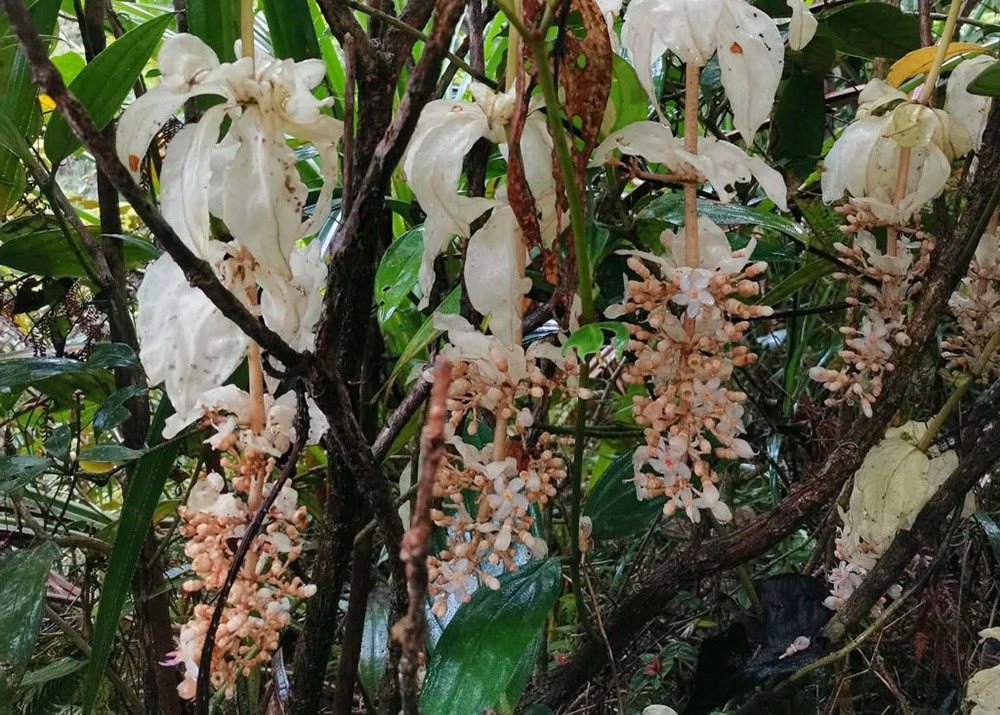
APAYAO, Philippines — A plant that grows commonly in a forest in Apayao but has escaped scientific recognition for more than a century has been identified as a new species, adding to the growing record of botanical discoveries in the province.
Named Medinilla bulutiorum, the plant was documented in Calanasan and formally described in the international scientific journal Phytotaxa on November 18, 2026.
The newly described M. bulutiorum closely resembles Medinilla magnifica but differs in its cylindrical branchlets, smaller leaves with five to seven prominent veins, more crowded flower branches, and a brown, scaly covering on its whitish flower stalks and bracts.
Researchers said the plant is ubiquitous in its type locality but remained unnoticed by botanists for more than a century, reflecting the limited systematic botanical exploration previously conducted in Apayao.
The latest finding follows the formal description of two other plant species associated with Calanasan and its surrounding forests in recent years. It further highlights the ecological importance of Calanasan, a municipality known for its Philippine Eagle nesting sites and forests that form part of the yApayaos Biosphere Reserve, which UNESCO recognized in July 2024.
In October 2025, researchers described Vaccinium kilangensis, a blueberry relative collected near Kilang Pass along the boundary of Apayao and Ilocos Norte.
In February 2026, another species, Medinilla calanasan, was formally described after researchers first encountered it during a November 2023 biodiversity survey in Barangay Eva, Calanasan.
According to the Provincial Government of Apayao, the researchers named the latest discovery in honor of the Bulut family, particularly the late Elias K. Bulut Sr., in recognition of the family’s leadership and stewardship of ancestral lands.
Despite its identification as a new species, researchers have preliminarily classified M. bulutiorum as Data Deficient under the International Union for Conservation of Nature’s Red List criteria. This means there is not enough information about its distribution and population to determine its risk of extinction.
Researchers said further field surveys are needed to establish the species’ distribution and population, while protecting its forest habitat remains important to its survival. (JDP/RGA-PIA CAR with reports from Apayao LGU/Photos from Jiro T. Adorador)