
BAGUIO CITY, Philippines – Mayor Benjamin Magalong outlined strategies to address challenges and seize opportunities, highlighting resilience, sustainability, and digital innovation as key priorities for the city’s future.
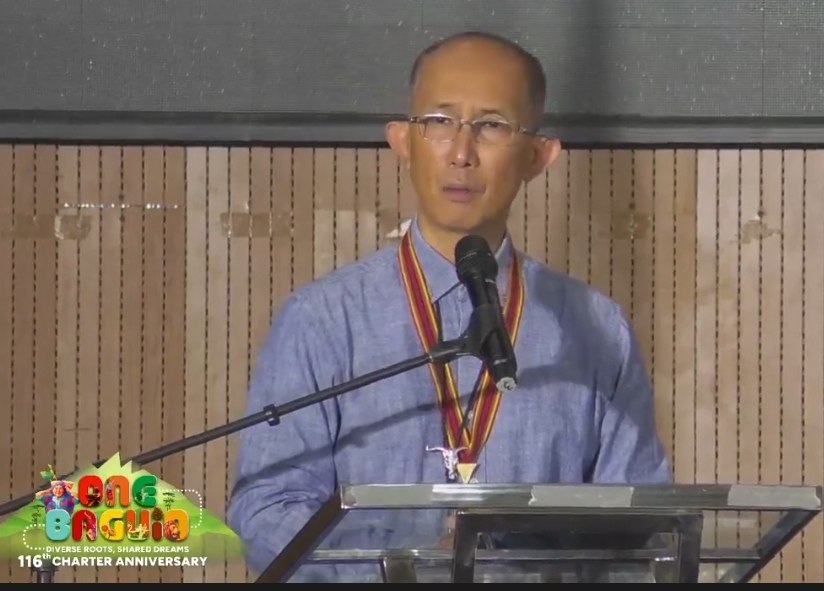
In his State of the City Address (SOCA) delivered during the 116th Baguio City Charter Day Anniversary program on Sept. 1, 2025, the mayor reported that Baguio, in partnership with UNDP Philippines, completed its first Voluntary Local Review (VLR) in June 2025, focusing on nine priority Sustainable Development Goals. The review showed encouraging progress in sustainable cities, climate action, education, and economic growth.
To strengthen governance, the city is also implementing the Performance Governance System (PGS), which emphasizes accountability and discipline. Workshops with the Institute for Solidarity in Asia were held last week to align local programs with long-term goals, with Baguio preparing for a Revalida assessment in December.
The mayor said part of sustaining this roadmap is finding the right partners as the government can not do everything alone.
“This is why we have embraced public-private partnerships as a way to bring in resources, expertise, and innovation while keeping the interests of our people at the center,” he said.
“The Intermodal Transport Terminal has been approved by the City Council and is now open for competitive challenge. The Market Redevelopment Project wasrecently approved by the City Development Council and has been endorsed to the City Council, while consultations continue for theSmart Urban Mobility Project. The Asin Hydro Project and TopinaoSocialized Housing Project will soon enter the negotiation stage. The Creative Center proposal is under negotiations.”
On infrastructure, the city vowed to intensify efforts to resolve the long-standing issue of “spaghetti wires” by working with telecommunications companies and enforcement personnel.
Baguio is also pushing for food security through its Smart Farming initiative, which has introduced solar-powered hydroponics in Pinsao Proper and Dontogan, established demo farms across barangays, and set up greenhouses for strawberry production. The city is now seeking national government funding to expand the program and move toward self-sufficiency.
A major priority, the mayor said, is resilience. Under the Making Cities Resilient 2030 (MCR2030) program, Baguio aims to achieve full resilience status by 2026—four years ahead of the global target. Plans include improving communication systems for faster disaster warnings and emergency coordination.
As part of its Open Government Partnership, the city also plans to adopt blockchain technology for government documents, including financial records, bidding processes, and infrastructure reports.
A Memorandum of Agreement with a local company is set to be signed next week to formalize the rollout, which aims to ensure transparency and prevent tampering.
“Growth brings both challenges and opportunities. The question now is how we move forward together to build a resilient, sustainable, and future-ready Baguio,” the mayor said.
In his SOCA, the mayor also highlighted the city’s major achievements on sustainability earning it global recognition.
He said that over the past year, Baguio advanced its vision for 2043 as a livable, inclusive, and creative city, anchored on the seven-point agenda.
Environmental stewardship remained a key priority, with an additional two hectares of canopy cover and the installation of a new air quality monitoring station at Burnham Park.
The city also ranked 5th cleanest in Southeast Asia in the 2024 Mid-Year Pollution Index.
Baguio formally launched its Circular Economy Project, “Pansa-Nopen Tayo,” on January 31, 2025, supported by the European Union and UNDP Philippines for effective and efficient waste management towards sustainability.
On resiliency, the city also earned a Beyond Compliant rating in the 2024 Gawad Kalasag Awards and a Future-Readiness Score of 61.1 percent from the Philippine Disaster Resilience Foundation.
On the global stage, Baguio was among only six cities worldwide honored with the 2025 Bloomberg Award for Global Tobacco Control, and previously won the Gold Seoul Smart City Award for its inclusive health governance system.
The mayor also reported strides in social services and infrastructure.
On health services, the city was given ₱53 million in funding under the Konsulta Primary Care Provider Network, improving 13 facilities and increasing manpower and equipment. Crime dropped by 2%, while both the City Jail and Fire Station were recognized as the best in their categories regionally.
Education also saw significant strides: Baguio ranked 1st in CAR and 2nd nationally in functional literacy, supported by programs such as the Barangay Pagbasa Program.
The SIGLAT Youth Innovation Hub engaged more than 4,000 young participants and 400 partners.
On infrastructure, the city completed multiple projects, including barangay halls, sports facilities, and the Halfway Home for rebel returnees. Major on-going works include the Athlete’s Quarters, Irisan Eco Park Phase II, and several barangay halls. The turnover of the Maharlika Livelihood Center in May 2025 is projected to generate ₱40 million in additional annual revenue.
Baguio continues to post strong economic performance, recording a 9% growth rate in 2023—the fastest in the Cordillera. Employment stood at 97.5% in 2024, inflation eased to 2.9% by mid-2025, and poverty incidence dropped to just 0.5% of families.
From June 2024 to May 2025, the city’s collections reached ₱2.734 billion, ₱249 million higher than the previous year. Baguio also ranked 12th among highly urbanized cities in the 2024 Cities and Municipalities Competitiveness Index, while securing multiple national and international awards in governance, tourism, and sustainability.
Magalong underscored that progress depends on active citizenship and collective responsibility, warning against corruption that has plagued other localities.
“Baguio is one of the few places in the country that has remained steadfast against corruption,” the mayor said. “This is a treasure we must safeguard at all costs.”
He also stressed the importance of youth participation and community solidarity:
“Good governance is not the burden of one—it is the shared duty of all. The progress we celebrate today is the collective strength of a community that refused to settle for less.”
As the city looks ahead to its vision for 2043, the celebration of 116 years of Baguio stood as both a reminder of its rich legacy and a call to build a resilient, inclusive, and forward-looking city for future generations. – PIO Baguio