


BENGUET, Philippines — Even with the advent of technology that helps improve production in the field of agriculture, the presence of agriculture extension workers in every barangay, municipality, province, and even cities has proven to be an important part in the process of effecting positive change, particularly in the lives of farmers in the communities and their families.
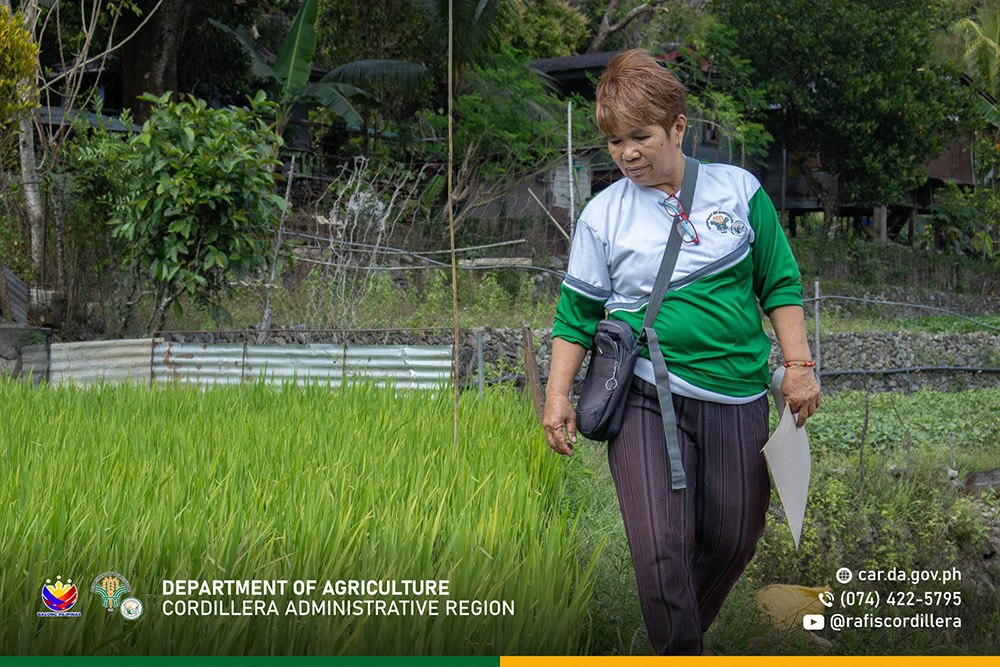
Leonora Carpio, a Barangay Agriculture Extension Worker (BAEW) and a woman leader of Tinongdan in Itogon, Benguet, practices participatory methods, recognizes and respects gender, identifies indigenous needs and problem solutions, and serves as a link for their local farmers to have access to programs and projects offered by the government such as the Department of Agriculture-Cordillera including the private sector.
As a woman leader, Leonora reiterates that her connection to her constituents is often an intimate relationship and one which demands much tact and resourcefulness. Being an agent for change, she intervenes to bring about change to help improve the lives of their farmers and their families.
Her intimate relationship among her constituents has allowed her to encourage their farming community to adopt the use of technology. As an extensionist, Leonora tries her best to make her constituents become aware of latest innovations and persuade them on the usefulness or importance of new technologies.
“Our continuous encouragement and assistance to our farmers in Barangay Tinongdan to consider the innovations and technologies introduced by the Department of Agriculture-Cordillera have assisted our farmers in improving their production of agricultural products even on a family consumption level. But what is important is that these agricultural products are produced safely,” Leonora said.
Aside from being a BAEW of Tinongdan, this woman leader is also a practicing farmer engaged in integrated farming by producing rice, vegetables, and ducks in their family’s farm, which also produces heirloom rice. She is proud to share that a greater number of the registered farmers in their barangay are composed of women.
“Of the 1,200 farmers registered in the barangay, majority of these farmers are women who are engaged in the production of rice, high-value crops, coffee, and corn that follow good agricultural practices. Even in our coordination meetings, most of the participants are women farmers who eagerly attend the said activity, to be aware and informed of the latest programs and projects of DA-CAR,” Leonora explained.
She also does her best to be an intermediary between researchers and farmers, and diagnoses problems of their constituents by advising them on how to resolve these challenges and difficulties.
“As we continue to follow good agricultural practices in our production of agricultural products, we remind our fellow farmers to prioritize the production of sufficient food for their families. Being one of the Barangay Agriculture Extension Workers of Tinongdan, we constantly notify our farmers on maintaining their production of agricultural products without using chemicals, and for them to be aware of interventions available from DA-CAR to improve their efficiency, productivity, overall livelihood, while reducing possible environmental impact,” Leonora added.
Tinongdan’s main source of income is agriculture, with the agricultural system ranging from the intensive type of wet rice planting to slash-and-burn cultivation of both grain and root crops. Significantly, taro and sweet potato are among the most preferred root crops, with taro considered very important to the Iwak tribe of the barangay as both a staple food and for ritual purposes.
Most residents of Tinongdan rely on agriculture for subsistence, including backyard gardening, mango production, and livestock raising. Other sources of income include gold panning, small and medium enterprises, and ecotourism.
Despite producing agricultural products primarily for subsistence, Leonora reiterates to her fellow farmers the importance of not selling their produce to ensure the availability of food for their families and their barangay. At the same time, staying true to the values and work ethic instilled in them by their ancestors, and ensuring that their legacy in agriculture lives on. // JTLlanes