

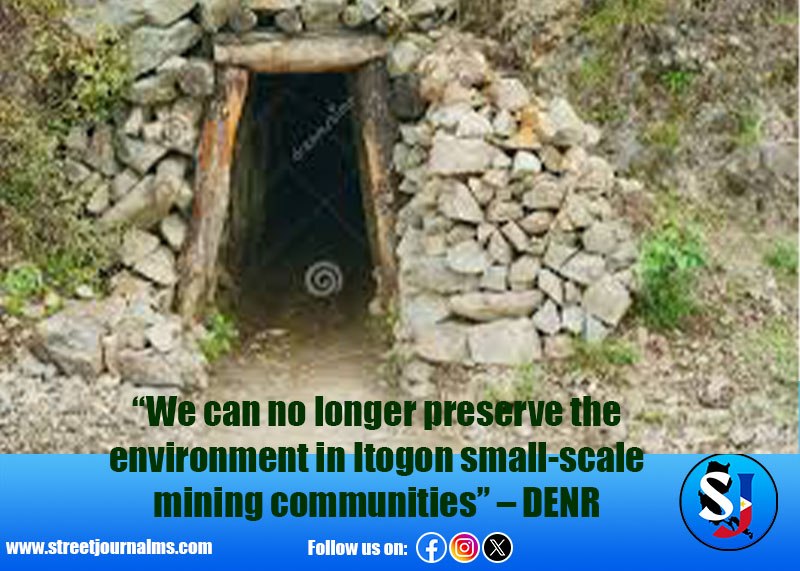
ITOGON, Benguet, Philippines — “We can no longer preserve the environment in small-scale mining communities in Itogon.”
This was the message of Marie Claire S. Luminang, Information Officer II of the Environmental Management Bureau of the Department of Environment and Natural Resources – Cordillera Administrative Region (EMB-DENR-CAR), during the Miners’ Forum held on June 10, 2026, at the Itogon Municipal Gymnasium in Poblacion.
Speaking on the topic “Beyond Preservation: Protecting and Sustaining Environments in Small-Scale Mining Communities,” Luminang delivered her address as part of the municipality’s Environment Month celebration.
Luminang explained that the concept of environmental preservation is no longer applicable in Itogon’s small-scale mining communities because preservation refers to protecting natural environments that remain largely untouched by human activity.
“But we can protect and adapt,” she emphasized.
She noted that while mining continues to provide livelihoods for many families, gold resources are finite and will eventually be depleted. She stressed the need for behavioral change—not only among miners but among all sectors of the community.
Luminang also challenged participants to examine whether some existing environmental initiatives are truly addressing the root causes of environmental degradation or merely serving as temporary, band-aid solutions.
“Are we really doing something about it?” she asked.
According to Luminang, environmental problems do not always require complicated solutions. The first step toward meaningful action is acknowledging the problem and taking responsibility for everyday practices that contribute to environmental protection. These include proper waste segregation at source and, where feasible, transitioning to mercury-free gold processing methods.
She explained that environmental protection involves reducing and preventing environmental damage such as pollution and soil erosion, safeguarding communities from hazards, promoting responsible use of natural resources, minimizing environmental impacts, and undertaking rehabilitation and restoration efforts.
Environmental adaptation, meanwhile, focuses on modifying existing practices to respond to the realities of mining environments. Examples include progressive rehabilitation of mined-out areas while operations are ongoing, establishing buffer zones near rivers and residential areas, and restricting mining activities on steep slopes and in protected areas.
She also highlighted measures to protect water resources, including the construction of sediment traps or settling ponds, preventing the discharge of untreated waste into rivers, and promoting water reuse.
Recognizing that small-scale mining remains a primary source of income for many residents, Luminang said it is disheartening to see miners receive all the blame whenever disasters strike mining communities.
“The goal is not to eliminate livelihoods,” she said, “but to align them with environmental responsibility and long-term sustainability.”
She further urged communities to begin preparing for a future beyond mining.
“What happens after we have mined it all out?” she asked.
Luminang emphasized the importance of developing alternative skills and livelihood opportunities to ensure that future generations will continue to have sustainable sources of income even after mining resources have been exhausted.