


By Jordan G. Habbiling
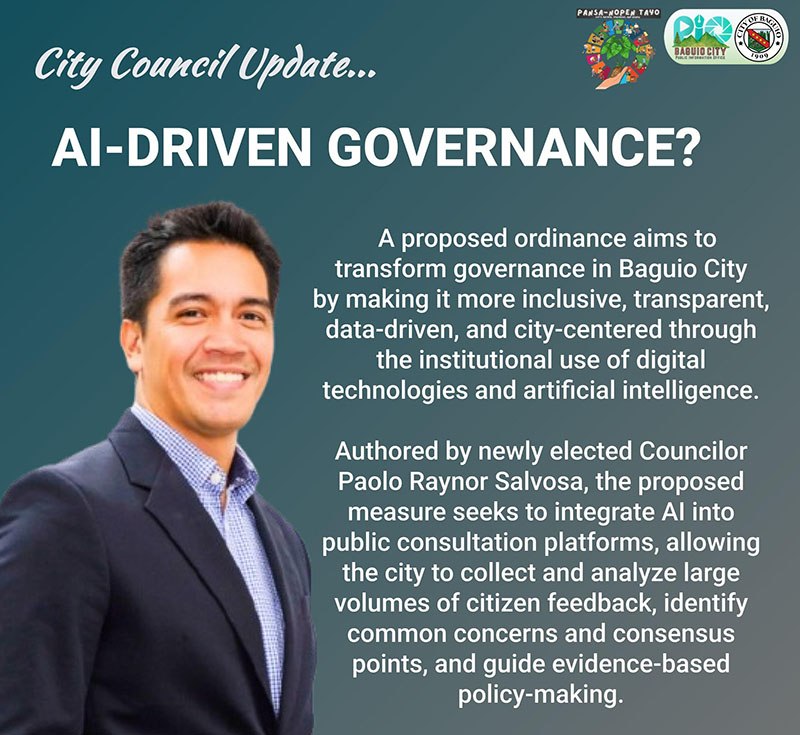
A proposed ordinance aims to transform governance in Baguio City by making it more inclusive, transparent, data-driven, and city-centered through the institutional use of digital technologies and artificial intelligence (AI).
Authored by freshly elected Councilor Paolo Raynor Salvosa, the proposed measure seeks to integrate AI into public consultation platforms, allowing the city to collect and analyze large volumes of citizen feedback, identify common concerns and consensus points, and guide evidence-based policy-making.
Salvosa cited successful international models like the platforms and systems used by Taiwan, Canada, and Estonia which use AI to process citizen input and shape tech-related policies, interpret public sentiment in urban planning, and enhance service delivery.
According to the proposed ordinance, online platforms will be widely used for the conduct of public consultations by the city government. However, AI systems must prioritize feedback from verified residents and voters and include residency verification tools in weighing public input.
This prevents tourism-related feedback or outside influence from distorting governance decisions in order to preserve a policy-making mechanism that prioritizes the community. Such AI systems must be inclusive, simple, and feedback-driven.
In terms of enhancing the accessibility of public records, the ordinance mandates that official documents such as ordinances, resolutions, and issuances be made available in machine-readable formats and not just scanned PDFs to enable AI-assisted search and filtering.
This will also make data-mining more efficient for citizens and decision-makers.
Likewise, the ordinance encourages pilot testing of AI tools and competitive partnerships with tech providers. It also encourages youth engagement through hackathons and design consultations.
However, Salvosa emphasized that AI must serve the citizens and not the other way around. The ordinance proposes a human-centered design where AI supports and not replaces human decision-making.
The ordinance also includes security measures like bot detection, deepfake identification, anomaly tracking, and sentiment analysis to safeguard platforms from manipulation; data privacy compliance, following the Data Privacy Act of 2012; and modern mechanisms to protect users from cyberbullying and digital harassment.
The proposed ordinance has been approved on first reading by the Baguio City Council and referred to the Committee on Laws and Governance for review.