


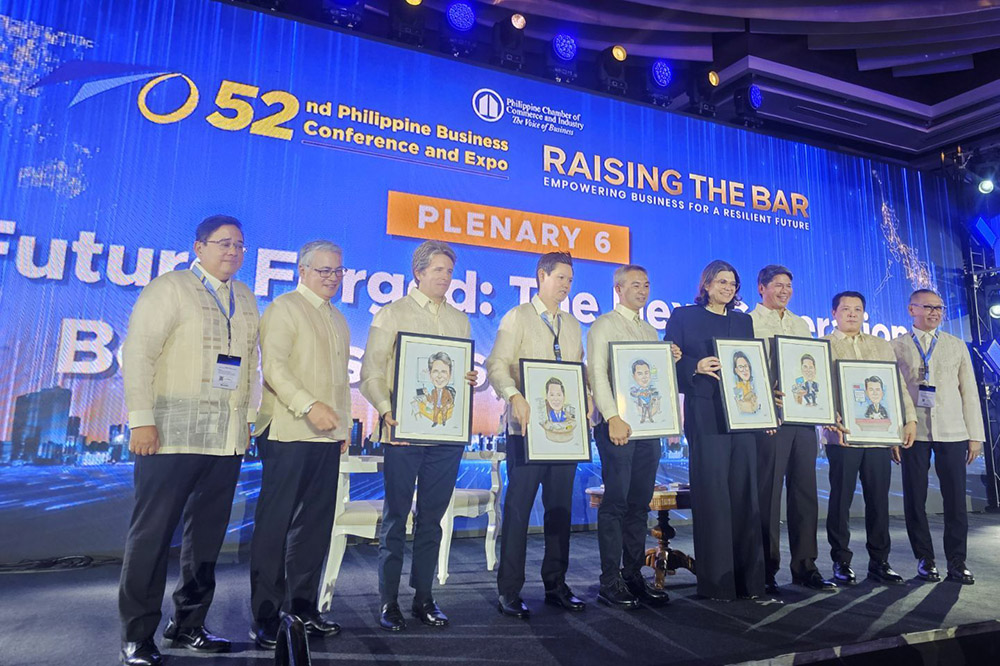
The Manila Hotel, Philippines — At the 52nd Philippine Business Conference and Expo by the Philippine Chamber of Commerce and Industry, Aboitiz Power Corporation (AboitizPower) encouraged businesses to take advantage of the Retail Competition and Open Access (RCOA) program and rooftop solar to help lower their power bills.
Speaking during a panel discussion, AboitizPower Chief Corporate Services Officer Carlos Aboitiz spoke in the context of tight supply conditions and the war in Iran, citing both as added pressures to the utility costs of businesses.
“There are a couple of things that businesses can think to do today to try to seek relief on the power rates side and lower their cost structures. The [Energy Regulatory Commission] is increasingly lowering the threshold for when businesses can source their power directly from retail electricity suppliers,” he said.
Beginning June 26, 2026, the eligibility threshold for RCOA was lowered from 500 kilowatts to just 100. AboitizPower is in the retail electricity supply space through wholly-owned subsidiary AdventEnergy.
“So that means [those] who have smaller businesses, who have in the past been limited to distribution utilities, you can now increasingly have the option to source directly from power companies who could provide lower cost of power,” he explained.
Aboitiz also raised installing rooftop solar as another option to minimize energy expenditure, adding that AboitizPower-backed Solviva Energy was the result of the company seeing the value of decentralizing energy.
“Rooftop solar and batteries are increasingly proliferating in the distributed energy space and costs are coming down. They’re very competitive. Your payback periods are somewhere in the range of 3-5 years at the moment, depending on what you’re investing in,” he said.
In the same event, Aboitiz also advised the audience to keep an open mind on the long-term possibility of deploying nuclear energy into the Philippine grid.
“I think we need to dare to be bold, especially in a time of challenge like we’re in today. An example of this in the energy sector is the idea of nuclear energy,” he said. “The Department of Energy and the national government today is daring to be bold with nuclear, and I think that the private sector is coming around to that.”
Aboitiz added that there are “a lot of possibilities” for the country to improve its energy future by investing in things like distributed energy and nuclear energy. While it seems out of reach today, Aboitiz believes that “it can be done” by working together, drawing on Filipino nuclear engineers currently working abroad, tapping into private capital, and maximizing government support.
“We have to find a way to look past the cynicism and dare to be bold as leaders in order to unlock new possibilities. There’s a lot of potential in this country but it’s hard to see that when things are so tough right now,” he said.
Last July, AboitizPower signed a Memorandum of Understanding (MOU) with Korea Hydro & Nuclear Power Co., Ltd. in Gyeongju, South Korea to explore cooperation on nuclear energy technologies and their potential applicability in the Philippines. Under the MOU, the two companies agreed to pursue joint pre-feasibility studies, information sharing, and capacity-building activities related to nuclear technologies.
“In the long term, the sector needs to work harder together to find ways to bring down the cost of power and to ensure the reliability of the system, while at the same time try to decarbonize our sector,” Aboitiz said.
“It’s not an easy thing to do. We have many islands that we need to connect. We have many challenges, from government [permitting] to land acquisition, [among] others that need to be hurdled.”