


By Ernie Delgado
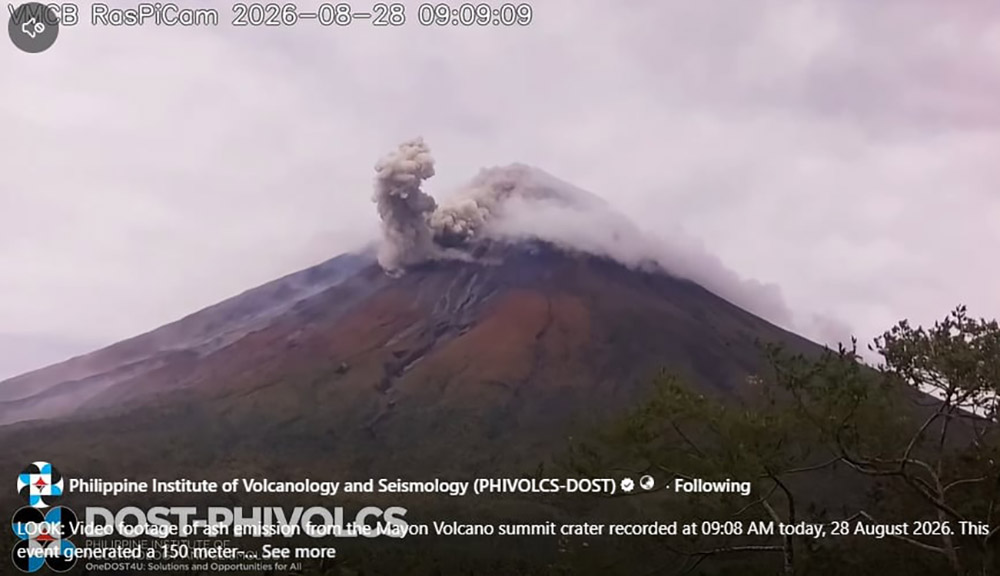
LEGAZPI CITY, Philippines — State volcanologists have recorded an “abrupt rise” in sulfur dioxide (SO₂) emissions from Mayon Volcano since Monday, indicating the possibility of a renewed eruption in the volcano.
In an advisory released on Tuesday, the Philippine Institute of Volcanology and Seismology (Phivolcs) reported that Mayon Volcano emitted 7,115 tons of sulfur dioxide (SO₂) on Aug. 31, the second-highest emissions recorded since volcanic gas concentrations began to decline on July 16.
Following this, Mayon emitted 6,981 tons of SO₂ on Sept. 1, and 6,931 tons yesterday, according to Phivolcs’ daily bulletins.
Since Mayon was downgraded to Alert Level 2 (moderate level of unrest) from Alert Level 3 (indicating an increased tendency toward a hazardous eruption) on Aug. 5, the average sulfur dioxide emissions have been 3,844 tons per day, according to Phivolcs.
Phivolcs said increased levels of SO₂ emissions from a volcano could be a warning sign that it may soon erupt again.
“Elevated volcanic SO₂ emissions could forewarn of a potential shift to renewed eruptive activity at the summit crater that could generate volcanic hazards all around the volcano,” the agency said.
The sharp increase was accompanied by a slight rise in low-frequency volcanic earthquakes (LFVQs), which are attributed to volcanic degassing.
From Sunday (Aug. 30) to Wednesday (Sept. 2), the Mayon Volcano Network had recorded 48 LFVQs, according to its daily bulletins.
Phivolcs said it also observed some signs of activity in the volcano’s northern and eastern areas, suggesting that there may be a slight increase in pressure.
However, the agency said the amount of seismic energy being released by the volcano is currently at normal levels.
Local governments were advised to prepare for a possible escalation of volcanic activity and a return to Alert Level 3.
While Mayon remains under Alert Level 2, which indicates the possibility of sudden steam-driven or phreatic eruptions, entry into the 6-kilometer permanent danger zone and flying close to the volcano are still prohibited, according to Phivolcs. (PIA Bicol)