


By Benilda Recebido
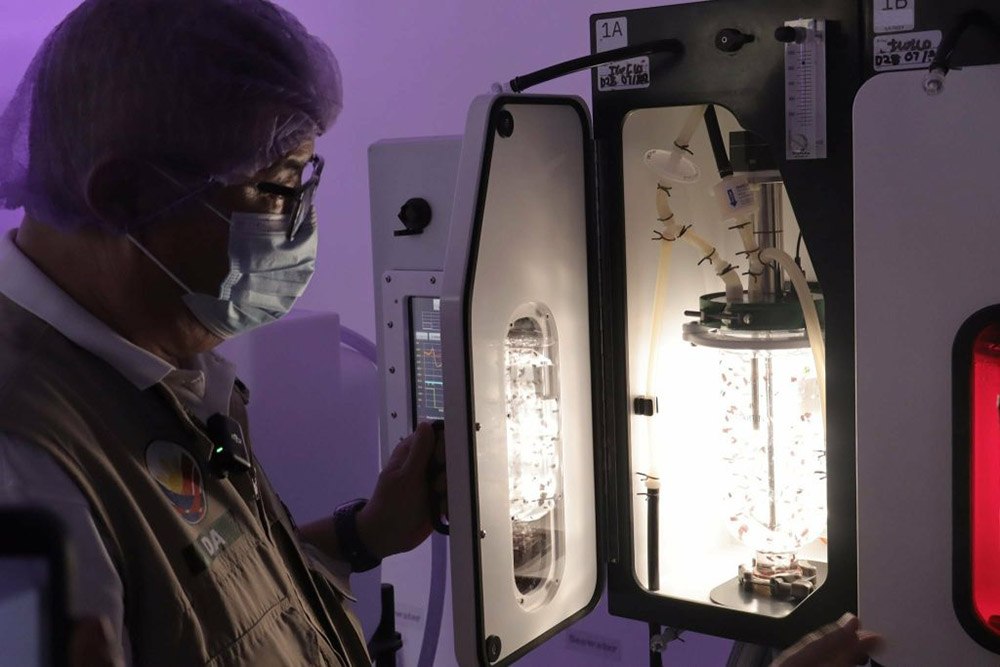
SORSOGON CITY, Sorsogon, Philippines — Agriculture Secretary Francisco Tiu Laurel Jr. inspected the country’s seaweed bioreactor facility at the Bureau of Fisheries and Aquatic Resources-National Seaweed Technology Development Center (BFAR-NSTDC) in Barangay Cabid-an, Sorsogon City on Monday, July 20.
During his visit, the agriculture chief emphasized that the project aligns directly with President Ferdinand ‘Bongbong’ Marcos Jr.’s directive to invest heavily in the seaweed sector, which remains one of the country’s top fisheries exports.
The newly established bioreactor project is designed to resolve the industry’s chronic shortage of high-quality planting materials.
The facility, which began operating in March this year, houses a huge 1,250L photobioreactor system explicitly optimized for macroalgae use. It operates around the clock to generate culture materials without relying on seasonal weather patterns.
According to Tiu Laurel, once fully operational, the facility will break away from traditional production constraints.
The facility will mass-produce premium planting materials 24 hours a day using advanced cultivation techniques,” he said.
“Its production capacity will jump tenfold compared to traditional methods, which are capped at just 10 tons per month, and we target a 95 percent survival and growth rate for distributed seedlings, a massive improvement from the historical 60 percent to 70 percent success rate that often led to wasted labor for farmers,” he added.
According to Tiu Laurel, the Philippines has only scratched the surface of its marine potential.
“While the local industry currently relies on just five commercially viable seaweed varieties, hundreds of other types remain vastly untapped,” he said.
The Sorsogon research facility will use its new machinery to accelerate research and development. Scientists will now have the technology to cross-breed species and develop high-yielding hybrids.
Also, the DA plans to expand seaweed utilization beyond food, exploring its high-value applications in pharmaceuticals and industrial sectors, and eventually, to position the Philippines as the global leader in seaweed production.
The project operates under the direct supervision of the DA and its attached bureau, the BFAR. Laurel noted that securing high-quality planting materials is the most critical component needed to revitalize local aquaculture.
“We are on the way to making our seaweed industry number one in the world,” Laurel stated, affirming the government’s commitment to empowering local seaweed farmers and maximizing the country’s marine economy. (Raiza Lucido contributed to this report/PIA Bicol/Sorsogon)