


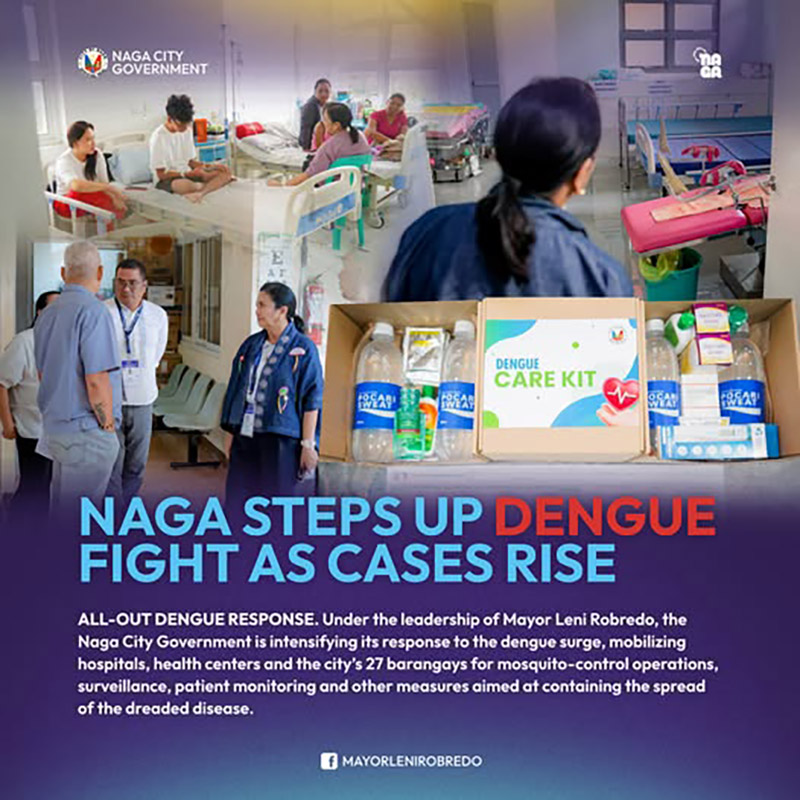
NAGA CITY, Philippines — Under Robredo’s leadership, the city government is leaving no stone unturned in its effort to contain the dengue surge, deploying every available resource—from mosquito-control operations and intensified surveillance to additional hospital beds, health personnel and home monitoring—to prevent further infections and ensure that patients receive the care they need.
The Naga City Government has intensified its campaign against dengue as the number of cases continues to rise, with barangays directed to step up mosquito-control measures while the Naga City General Hospital (NCGH) struggles to accommodate patients.
Mayor Leni Robredo said during her weekly press conference that the city government had provided all 27 barangays with insecticides for mosquito control, including appropriate treatments for mosquito breeding sites in bodies of water. The barangays were advised to conduct regular control measures, particularly in areas where Aedes mosquitoes may breed.
The NCGH has also opened 40 additional beds for dengue patients since last week, but Robredo said these have proven inadequate amid the continuing increase in cases. Beds have been set up in hospital corridors, while the third floor has also been opened to accommodate patients. She said long queues of dengue patients have also been observed at the emergency room.
“We have to augment the manpower complement of our personnel like doctors, nurses, medical technologists. Last week we hired several nurses as the first batch of what we need to hire, but we have to hire more. Hopefully, we can find additional number of doctors to augment the present manpower complement,” Robredo said.
The city’s four preliminary healthcare centers—the Super Health Center, Our Lady of Lourdes Infirmary, City Health Office 1 and City Health Office 2—have also started admitting dengue patients to help ease the pressure on NCGH. The city has recorded eight dengue-related deaths, while nearly 500 cases have been reported. As of Saturday, 79 cases were active.
Robredo said at least 20 percent of dengue patients confined at NCGH are not Naga residents. She has also required government and private hospitals to report their dengue cases to the city as part of its continuing surveillance and monitoring.
The city government has likewise procured Dengue Care Kits after NCGH doctors advised that patients who do not show warning signs could be monitored at home, helping prevent the hospital from becoming overwhelmed. The kits, distributed to households with dengue patients being monitored by their barangays, contain Pocari Sweat drinks, mosquito repellent lotion, a digital thermometer, alcohol, multivitamins, paracetamol, oral rehydration salts and monitoring sheets. Separate kits are provided for children and adults.
Robredo said patients with warning signs or those who have been suffering from fever for two days should be brought to a hospital. She also urged families to inform their punong barangay, health kagawad, and midwife or barangay health worker if a family member becomes ill so the patient can be monitored and given appropriate care.
She said barangays are being mobilized to conduct surveillance and the search-and-destroy of mosquito breeding sites, as the dengue campaign cannot be left solely to the city government because of the number of measures that need to be undertaken.
Aside from mosquito-control activities in the barangays, intensive fogging operations will be conducted in schools shortly before classes resume after the two-week suspension during the Peñafrancia fiesta. Robredo said the school break has also temporarily limited children’s exposure to dengue because they are not attending classes.
Robredo emphasized that monitoring should continue even after a patient has recovered, while barangays remain involved in tracking active and recovering cases as part of the city’s response to the dengue surge. I via Jason B. Neola, CMO-Public Information Division head