


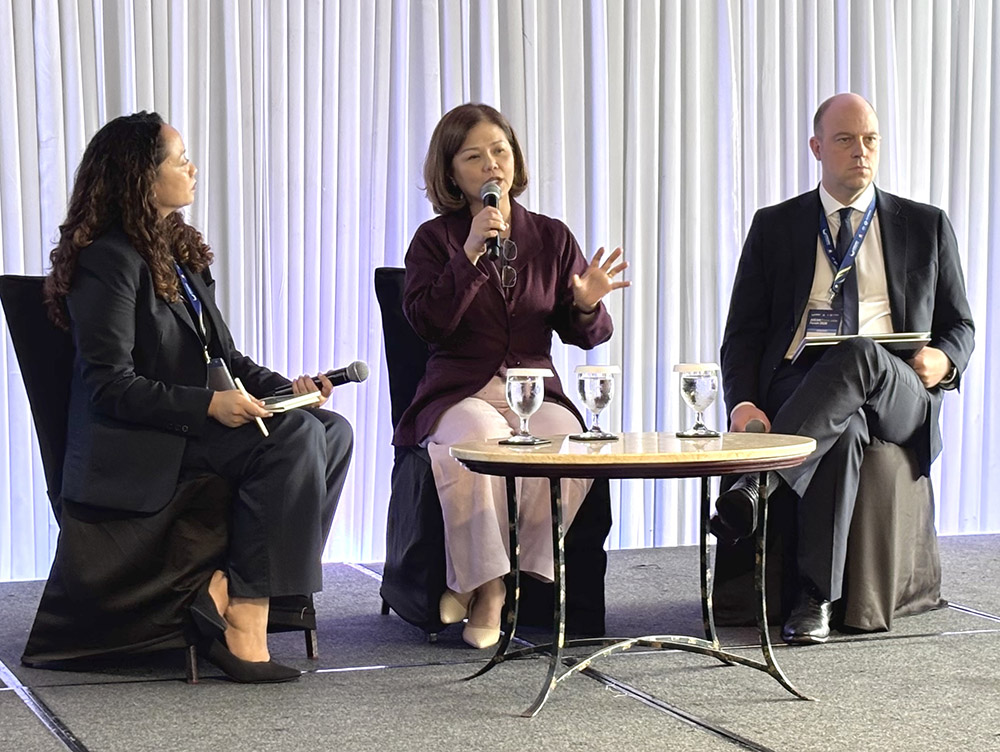
Equipping incumbent workers in the electric power sector with adaptive skills, technical expertise, and continuous learning capabilities is essential to driving a successful and inclusive energy transition, an official from Aboitiz Power Corporation (AboitizPower) maintained.
“Technologies will continue to evolve, and the skills required today will not be the only skills needed tomorrow,” said AboitizPower Chief Human Resources Officer Monette Lasala. “That is why building the workforce of the future is not just about training people for specific jobs. It is about developing people who can keep learning, think critically, adapt to change, and apply their expertise to new challenges.”
She spoke during a panel discussion at the ASEAN Green Jobs Forum 2026, an event hosted by the Department of Labor and Employment with support from the Australian Government through the Aus4ASEAN Futures Initiative.
“We believe that the energy transition is as much about developing people as it is about developing technology,” Lasala added. “Behind every technology are people who must know how to develop, operate, and make it work safely and reliably.”
She also explained that the Philippine energy transition involves more than just expanding cleaner energy sources; there is also a need to operate and modernize existing assets to maintain a reliable power supply. “This creates a dual workforce challenge. We need people who can build and manage renewable energy systems, while also helping modernize conventional power generation through digital technologies.”
The ASEAN Green Jobs Forum is an annual flagship knowledge-sharing platform established in 2024 to promote and advance the green jobs agenda across ASEAN Member States.
ASEAN, or the Association of Southeast Asian Nations, understands green jobs as decent jobs in economic sectors which reduce negative environmental impacts.
An ASEAN study estimates that approximately 24% of occupations can potentially be performed in “greener” ways with appropriate training, equipment, and tools. As of the first half of 2024, the Philippines’ share of employment in green occupations stood at 0.8%, while the ASEAN unweighted average sat at 1.3%.
“It is not [about] introducing new occupations. It’s about reskilling existing occupations,” said Australia’s Future Skills Organization Strategy and Planning Director Timothy Burt in the same panel. “The feedback we consistently get is that people just need additional skills on top [of what they already know].”
An economist from the Organisation for Co-operation and Development (OECD) also noted that traditional occupations are also becoming more digital.
“A normal electrician nowadays would require knowledge to work with a smart system, smart energy systems, [and] connected devices… Maintenance technicians need to use more sensor and predictive maintenance software,” observed OECD Directorate for Employment, Labour and Social Affairs economist Michele Tuccio.
To help address the need for upskilling the workforce, AboitizPower and JERA Co., Inc. launched the Global Technical Center of Excellence (GTCOE) at the LIMA Commercial Center, LIMA Estate in Batangas last September 2025. The GTCOE’s courses, which includes its flagship three-month Operations & Maintenance Basic Training Program, emphasizes safety, technical mastery, adaptability, collaboration, and communication.
“Industry understands the technologies, operational requirements, and competencies needed in the workplace. Educational institutions help develop foundational knowledge and emerging talent. The government can help create an enabling environment for skills development and green job creation,” Lasala said. “These efforts must reinforce one another.”
Observing similar efforts in some OECD member countries, Tuccio said that many green job opportunities are accessible, not only through university, but also through technical vocational pathways.
“For example, EV maintenance, solar installations, [and] smart manufacturing operations — somehow there is this potential to train these people without necessarily sending them through long degree programs,” he said.
The ASEAN Green Jobs Forum 2026 supplements the Philippines’ hosting of the 49th ASEAN Summit and Related Summits from November 15 to 18, 2026 in Metro Manila. The country serves as this year’s ASEAN Chair.