

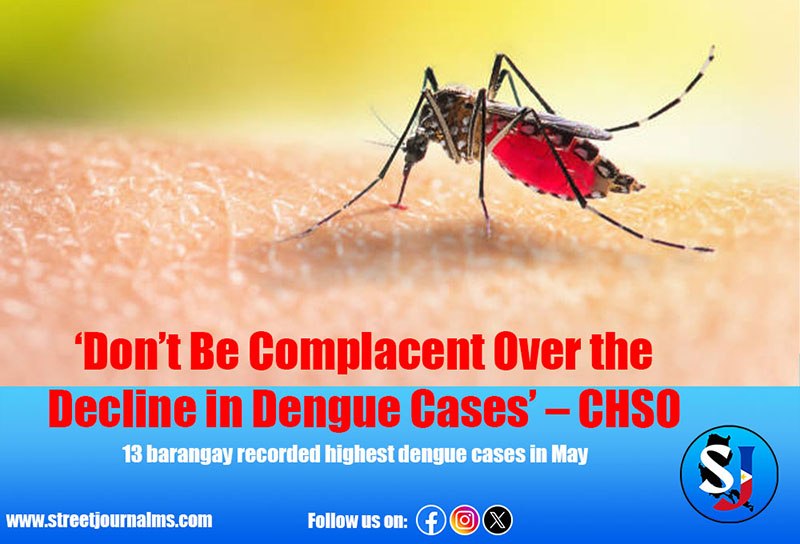
BAGUIO CITY , Philippines – “Don’t be complacent, don’t let your guard down, and continue to follow mosquito control measures to prevent the possible return of the disease.”
This is the urgent call of the City Health Services Office (CHSO) despite a significant decline in dengue cases in the city this year.
According to CHSO Officer Dr. Celia Flor Brillantes and Dengue Program Coordinator Miller Balisongen of the Environmental Health and Sanitation Division, the current dengue situation “may not be very alarming, but it should not be a passport to be careless about our environmental health.”
Dengue Cases Down by 57%
Based on local data, Medical Technologist Ruby Magsino of the City Epidemiology and Surveillance Unit (CESU) reported that dengue cases decreased by 57 percent compared to last year.
The city’s epidemic curve currently remains below the alert and epidemic threshold.
*Current Data: From January 1 to May 30, 2026, the city recorded 196 dengue cases—a 50 percent drop from the 394 cases reported during the same period last year.
*Demographics: Individuals aged 15 to 29 accounted for 43 percent of the reported cases, while 36.2 percent of the total cases required hospitalization.
*Affected Areas: Currently, 13 barangays have recorded cases. Barangay Irisan reported the highest number in May with three cases, while Dominican Hill-Mirador and Middle Quirino Hill have recurring cases. Meanwhile, the barangays of Aurora Hill, Bakakeng Central, BGH Compound, Cabinet Hill-Teachers Camp, City Camp Central, Dontogan, Kias, Legarda-Burnham-Kisad, and San Vicente each recorded one isolated case.
Despite the low numbers, health officials warned that an increase in cases is expected in the coming weeks due to the rainy season, which creates breeding grounds for deadly mosquitoes.
City Government Steps Up Strategies
To tackle mosquito-borne diseases—which also include Zika virus and Chikungunya—the city government has rolled out strategic campaigns under the guidance of the National Aedes-Borne Viral Diseases Prevention and Control Program.
Mayor Benjamin Magalong previously issued Executive Order No. 57-2026, re-establishing the Baguio City Anti-Mosquito Borne Diseases Committee (BCABDC) pursuant to Ordinance No. 10-2025, also known as “The Consolidated Anti-Mosquito-Borne Diseases Ordinance of the City of Baguio.”
The city is currently formulating an active agenda for the third quarter of 2026, featuring:
*Baguio City Dengue Summit 2026: To be held under the theme “Pan-iinabuyugan: Baguio City Dengue Summit: One Health, One Baguio, One Dengue-Resilient Community.”
*Search for the “Top Rated Barangay for Dengue Prevention and Control Program”: An initiative to encourage local leadership. Participating barangays will be evaluated based on policy compliance, community mobilization, Social Behavioral Change Communication (SBCC) campaigns, governance, and program innovation.
*On-the-Ground Vectors Control: Ongoing larval surveillance in the top 20 affected barangays, product demonstrations for an Ovicidal-Larvicidal (OL) Trap Project, and the procurement of space spraying chemicals and thermal fogging machines.
In line with National Dengue Awareness Month (Proclamation No. 1204, s. 1998) this June and ASEAN Dengue Day on June 15, the city has scheduled a Symposium cum Orientation for Barangay Health Workers (BHWs) to streamline case reporting and verification mechanisms at the community level.
Residents Urged to Strengthen Prevention at Home
The CHSO Environmental Health and Sanitation Division is strongly urging parents and guardians to take proactive steps to protect children by ensuring their homes remain free of mosquito breeding sites.
Engr. Albert Pay-an, Head of the Environmental Health and Sanitation Division, emphasized that the home serves as the most critical health checkpoint in a child’s daily life. “The most important health checkpoint in a child’s day is not school, but home,” Pay-an said, highlighting the vital role of families in preventing infection.
The CHSO advises households to: 1.Regularly check surroundings for stagnant water where mosquitoes can breed. 2. Apply mosquito repellents and dress children in long clothing. 3. Consult a doctor immediately at the nearest health center if dengue symptoms appear.
“Prevention of dengue starts at home. An uncovered container can harbor hundreds of mosquitoes. When families consistently take small actions, the entire community becomes safer,” Pay-an added.
The CHSO emphasized that preventing mosquito breeding in a household goes a long way in protecting the entire neighborhood from dengue and other mosquito-borne diseases.
The CHSO is also stepping up dengue prevention efforts as the rainy season begins with the opening of the new school year.
The CHSO, through its City Epidemiology and Surveillance Unit (CESU), continues to monitor dengue cases in all barangays.