

By Debbie E. Gasingan
BAGUIO CITY, Philippines — The Cordillera Regional Disaster Risk Reduction and Management Council (RDRRMC) encourages the public to prepare for the ‘worst-case situations’ as PAGASA reports that El Niño will intensify over the coming months and will persist until early next year.
DOST-PAGASA reported on June 24, 2026, that there’s a 69 percent possibility that a strong El Niño is likely to emerge by the August-September-October season and over 62% that a very strong El Niño is favored during the October-November-December and November-December-January seasons.
Office of Civil Defense Cordillera regional director and Cordillera RDRRMC chairperson Albert Mogol said that various sectors will be affected once the strong and very strong El Niño emerge.
Preparedness measures should focus on water, food and energy security, as well as on health and public safety.
“Affected po ‘yung ating energy kasi mas marami ang gumagamit ng kuryente kasi masyadong mainit. Of course, affected din dito ‘yung ating fuel supply, and thirdly is ‘yung water, food, and agriculture,” Mogol said during the Kapihan sa Baguio on June 29.
He also noted a decrease in water levels of dams and rivers, particularly in areas that have not experienced any rainfall over the past months.
“Ito po ‘yung dapat nating paghandaan. Even in other countries, nakaka-experience ng water shortage. Dapat pagtuunan natin ng pansin, ano ba ang dapat nating gawin,” he emphasized.
Mogol mentioned exploring alternative solutions to help ensure a sustainable water supply. He cited Singapore as an example, noting that the country has established several water desalination plants, converting seawater into safe, potable fresh water. Relying on Reverse Osmosis, this uses high-pressure pumps to force water through semi-permeable membranes that block salts and impurities, producing millions of gallons of drinking water daily.
“’Yun pong tubig-dagat ay kino-convert nila into potable water at kaya naman po nating gawin ‘yan kung gagawin natin. Ang tubig, hindi natin magiging problema kung ito ay ating pinaghahandaan… pag-aralan din siguro,” he said.
The director said that an El Niño Response Plan is already in place in the region, with various agencies working in close coordination to mitigate the effects of the phenomenon.
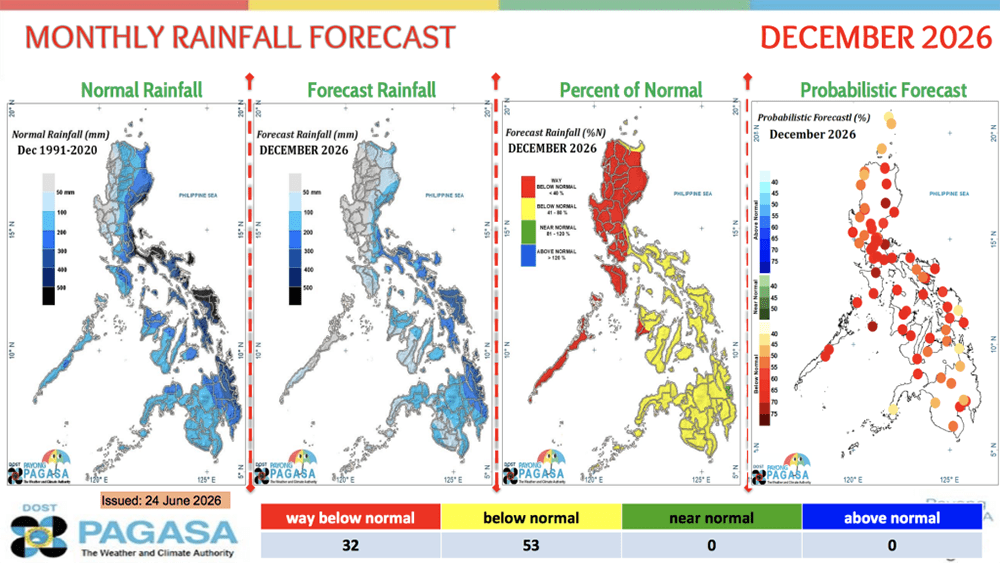
Based on the climate outlook released by the weather bureau, the whole of Cordillera might experience dry conditions by the end of November 2026.
Dry condition is defined as two consecutive months of below-normal rainfall condition or 21-60% reduction from average rainfall.
By the end of December 2026, the region is forecasted to experience a dry spell or three consecutive months of below normal rainfall condition or 21-60% reduction from average rainfall. (JDP/DEG-PIA CAR)