

Street Journal Multimedia Services

Business

Globe Business shares cloud strategy blueprint for smarter, safer operations

Business

Many companies have already made the move to the cloud, hoping to unlock new growth, flexibility, and innovation. But not all are getting the full value out of that shift. At one of the breakout sessions during G Summit 2025, Globe Business experts tackled a growing challenge. While 85% of enterprise workloads are expected to be in the cloud this year, many businesses still face slow performance of infrastructure and systems, rising operational costs, and security gaps. The solution, they said, lies in a holistic architecture that seamlessly integrates cloud, connectivity, and security, forming the foundation for a future-ready enterprise. These elements must work as one to unlock the promise of digital transformation. “Cloud is not just about storing files or using apps online. It’s how today’s businesses operate,” said Gerald Manalo, Solutions Consultant at Globe Business. He stressed that without proper connectivity and security woven into its fabric, the cloud ecosystem becomes fragile and underperforms. “Choosing the right connection to the cloud directly impacts performance, cost, and crucially, security.” This is precisely where Globe Premium Cloud Connect (GPCC) comes in. It provides a dedicated, private connection between a company’s systems and cloud platforms, such as AWS, Azure, and Google Cloud. This private path to the cloud, distinct from the risks of the shared internet, ensures reliable performance, secure data transfer, and significantly reduces cloud egress costs. GPCC further enhances uptime and robustly supports real-time applications, thereby improving the overall resilience and efficiency of the cloud ecosystem. Beyond just connectivity, a proactive security strategy is also a crucial requirement, keeping threats in check before they cause damage. Saravanan Rajasekaran of Versa Networks introduced the idea of a self-protecting network, an intelligent system that can detect, respond to, and even anticipate threats. “Security must be foundational—not an afterthought retrofitted onto your network. It should be intrinsically woven into every layer of your infrastructure, from LAN and WAN to hybrid workforces, Data Centers, and Cloud/SaaS access,” he said. Meanwhile, Varunendra Tripathi of Orca Security stressed the importance of visibility. “You can’t protect what you can’t see,” he said. “With full visibility across your cloud environments, you can prioritize risks, cut through the noise, and act before threats turn into real problems.” The breakout concluded with a fireside chat among the speakers, where they echoed one shared message: the future of business depends on proactive, integrated strategies. From fast and secure connections to intelligent, built-in protection, digital resilience begins with the right foundation. “The future of business demands not just cloud adoption, but intelligent cloud integration to truly thrive,” said KD Dizon, Head of Globe Business. “At Globe Business, our purpose is to empower Filipino enterprises to navigate this shift. Through platforms like G Summit and our integrated solutions, exemplified by offerings like GPCC, we equip businesses with the strategies and tools to build resilient, future-ready operations. This contributes to a digitally empowered nation and also provides businesses the control and confidence to scale faster, operate smarter, and protect what matters most.” Globe Business continues to help organizations navigate their digital journey through innovative cloud strategies, dedicated connectivity, and partner-driven security solutions.      

Cebu Pacific reaches 100th Aircraft Delivery with New A330neo, First in PH History

Business

Cebu Pacific (PSE: CEB), the Philippines’ leading airline, has reached a historic milestone as it becomes the first local carrier to operate a 100-strong fleet with the delivery of its latest aircraft — a brand new A330neo. The A330neo is also the 12th aircraft of its kind to join CEB’s fleet, reinforcing the airline’s position as the largest A330neo operator in the Asia-Pacific. The 459-seater aircraft, which arrived in Manila from Airbus’ facility in Toulouse, France, is the second of four A330neos expected to join CEB’s fleet this year — the first of which arrived on March 28. CEB is expecting a total of seven aircraft to be delivered in 2025. “Reaching 100 aircraft is more than a milestone — it reflects our unwavering commitment to make air travel accessible to more Filipinos,” said Xander Lao, CEB President and Chief Commercial Officer. “With a larger fleet, we’re able to operate more efficiently, enhance connectivity across the country and the region, and pass on the benefits of scale through even lower fares.” This milestone comes amid continued passenger growth. In June 2025, CEB flew a total of 2.2 million passengers, marking a 7.9% increase from the same month last year. From January to June, the airline has flown 13.9 million passengers, marking a 21% increase from 11.5 million in the first half of 2024. The A330neo provides CEB with the flexibility to serve regional and long-haul routes, as well as high-demand sectors. With increased range and capacity, the aircraft enables the airline to optimize its operations while maintaining cost efficiency. Airbus NEOs are the latest-generation aircraft that burn up to 25 percent less fuel per flight and produce less noise compared to the previous generation. The decrease in fuel consumption leads to a corresponding reduction in aircraft carbon emissions. CEB operates one of the youngest fleets in the world, with its diversified fleet mix of 12 Airbus A330s, 40 Airbus A320s, 26 Airbus A321s, and 22 ATR turboprop aircraft, enabling the widest network coverage in the Philippines.

Cebu Pacific Records 2.2M Passengers in June, Seat Load Factor Reaches 87.5%

Business

  Cebu Pacific (CEB) carried 2.2 million passengers in June 2025, a 7.9% increase compared to the same period last year. Seat load factor (SLF) decreased to 87.5% from 88.3% last year while seat capacity grew by 8.8%. Domestic passengers grew 7.3% versus June 2024 on 6.8% higher seats, with a SLF of 92.1%. International passenger traffic, meanwhile, grew 9.7% year over year on 14.2% higher seats, which resulted in a 3.1 percentage point decrease in SLF to 76.1%. For year-to-date 2025, CEB passengers grew to 13.9 million, marking a 20.8% increase from 11.5 million in 2024. Domestic passengers grew 20.4% to 10.4 million, while international passengers grew 22.3% to 3.5 million. SLF averaged 85.4%, while overall capacity in seats grew 20.6% to 16.3 million. “Despite the earlier onset of the academic calendar – moving the start of classes from late July last year to mid-June this year – passenger traffic and seat load factors remained resilient. Domestic demand remained strong shown by its 92% load factor while international traffic grew by over 9% as we invested in connecting cities outside Manila to more international ports,” said Xander Lao, President and Chief Commercial Officer of Cebu Pacific. “For the first half of 2025, our load factors have increased despite seat growth of more than 20%. This reflects the continued strength of air travel demand within our network. Capacity for the second half of June was reduced due to the commencement of the leaner season. This also aligns with ongoing proactive management of engine and supply chain issues and as such we would expect capacity growth levels to stay at similar levels through the third quarter before rising again in the fourth quarter.”    

BCDA breaks ground on New Clark City affordable housing under  PBBM’s 4PH

Business

The Bases Conversion and Development Authority (BCDA) on Thursday, July 10 broke ground on a new affordable housing development in New Clark City, marking a key milestone in the implementation of President Ferdinand R. Marcos Jr.’s flagship Pambansang Pabahay Para sa Pilipino (4PH) Program. The project, launched in partnership with the Department of Human Settlements and Urban Development (DHSUD) and consortium of Sta. Clara International Corporation and South Korea-based Saekyung Unitless Co., is part of a broader push to address the country’s housing backlog through inclusive, people-centered urban development. Located in Capas, Tarlac, the site will initially deliver 840 housing units under the 4PH program. These units form part of a larger, masterplanned 5.84-hectare community that will eventually offer more than 3,400 residential units, including mid-rise buildings for affordable housing. “This housing project is a testament to the bold vision of President Marcos Jr., brought to life through 4PH. It tells every Filipino family: you deserve more than shelter. You deserve a home—a place of dignity, stability, and hope,” said BCDA President and CEO Engr. Joshua M. Bingcang. The development supports President Marcos Jr.’s goal of building one million housing units annually, and aligns with BCDA’s mandate to build smart, sustainable cities that generate long-term social and economic value. “This is a real and tangible step forward in our collective pursuit of a new Philippines–Bagong Pilipinas–where housing is a right, not a privilege; where communities are safe, sustainable and inclusive; and where every Filipino can dream of owning a home and actually be able to achieve ownership,” said DHSUD Undersecretary for Freeport Economic Zones Engr. Emmanuel D. Pineda. Beyond housing, the New Clark City Affordable Housing Project integrates green parks, community spaces, sports and recreation facilities, and retail zones, while offering future residents access to nearby national institutions and job hubs. Notably, the community will also serve as a potential housing site for uniformed personnel, allowing them to live closer to their place of duty. Situated within BCDA’s flagship New Clark City, the project benefits from significant infrastructure investments, including the New Clark City–MacArthur Highway Connector Road and Connecting Road Package 2, which link the city to the Virology and Vaccine Institute of the Philippines, the Bangko Sentral ng Pilipinas complex, and the National Academy of Sports. New Clark City is currently host to Php274.53 billion in pledged investments from locators, including Filinvest Land, Hann Development, and the StB Giga Factory, with projected employment generation exceeding 150,000 jobs. Consistent with New Clark City’s vision as a climate-resilient and people-first metropolis, the housing complex will feature modern utilities, stormwater drainage systems, fire protection infrastructure, and open green spaces. Employment during construction and operations will also prioritize local hires from Capas and surrounding towns. “This groundbreaking ceremony marks the first step towards the change needed to bring the Filipino dream to life. With this project, we are building hope, we are empowering Filipinos, and we are bringing a lasting impact that will ripple for generations to come,” said BCDA Chairperson Atty. Larry Paredes. The New Clark City Affordable Housing Project is set to begin vertical construction by late 2025, with the first units expected for turnover within two years.            

Cagayan Valley MSMEs Take Center Stage: Over 200 Entrepreneurs Gather for 3rd Regional Summit in Nueva Vizcaya

Business

By Rachel Magday   More than 200 micro, small, and medium enterprises (MSMEs) from across the Cagayan Valley region have converged at the Carlos M. Padilla Convention Center,Provincial Capitol,Bayombong for the 3rd Regional MSME Summit 2025, a two-day event dedicated to empowering local entrepreneurs and boosting regional economic growth. The summit, which runs until tomorrow, is spearheaded by the Department of Trade and Industry (DTI) Cagayan Valley in partnership with the Provincial Government of Nueva Vizcaya. This year’s theme, “Asenso Negosyo, Angat Kabuhayan: Bagong Pilipinas,” underscores the drive to uplift businesses and improve livelihoods through government support, innovation, and collaboration. DTI Regional Director for Cagayan Valley, Ma. Sofia Narag, highlighted in her message that the summit brings together national government agencies, MSMEs, and other organizations to make vital government services and programs more accessible to entrepreneurs. Over the two-day event, representatives from these agencies will detail how their programs can help MSMEs scale up and thrive in an increasingly competitive market. Although Nueva Vizcaya Governor Jose V. Gambito was unable to attend the summit due to another equally important engagement, he conveyed his strong support for the DTI and its initiatives. Governor Gambito emphasized the crucial role of MSMEs in driving inclusive local economic growth and reaffirmed the provincial government’s commitment to partnering with the DTI in sustaining programs that address the needs of small businesses. He also encouraged MSMEs to seize the opportunities offered by the summit to further develop their enterprises and contribute to the province’s progress. Key local leaders, including Congressman Atty. Timothy Joseph Cayton and Vice Governor Eufemia Ang Dacayo, were also in attendance and expressed their full support for the DTI and its programs for MSMEs. Both officials underscored the importance of strengthening the MSME sector as a cornerstone for sustainable development in Nueva Vizcaya and the entire Cagayan Valley region. Among the highlights of this year’s summit are new events such as a trade fair, a product standards showcase, and a “Diskwento Caravan,” all aimed at supporting and promoting MSMEs in the region. These activities provide a platform for local entrepreneurs to display their products, learn about quality standards, and access discounted goods and services.    

U.S., Philippines Sign Subic-Clark-Manila-Batangas Railway Agreement 

Business

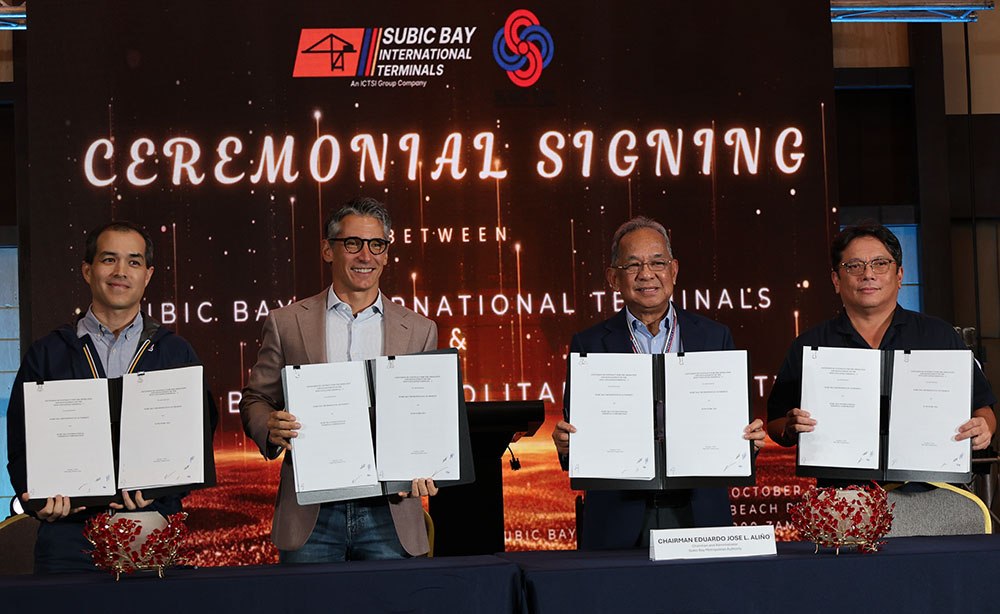
The United States government, through the U.S.Trade and Development Agency (USTDA) and the Philippines’ Department of Transportation (DOTr), announced funding for technical assistance for the construction of the Subic-Clark-Manila-Batangas (SCMB) Railway, which is designed to link three major ports in Luzon and decongest traffic at the Port of Manila. Secretary Frederick D. Go, Special Assistant to the President for Investment and Economic Affairs, said the railway project boosts the initiative of linking major economic hubs under the Luzon Economic Corridor. “We are grateful for the support in advancing this crucial infrastructure project, which will drive economic growth by improving connectivity between major ports and industrial hubs along the Luzon Economic Corridor. Once operational, the SCMB Railway will attract investments, create new opportunities for businesses, and most importantly, generate quality jobs that will benefit millions of Filipinos,” Secretary Go said. USTDA said its technical assistance for the SCMB Railway involves transport model development, port-rail integration study, and legal and institutional framework analysis, among other areas. “This project underscores the U.S.-Philippine alliance’s vital role in maintaining a free and open Indo-Pacific region. By supporting the development of the SCMB Railway, we are ensuring that key infrastructure will flourish, increasing economic cooperation to develop an essential trading route that will mutually benefit American and Philippine citizens,” said Thomas R. Hardy, USTDA’s Acting Director. “Our partnership with the Philippines exemplifies the strength of American leadership in the Indo-Pacific and underscores our commitment to advancing our shared interests.” Transportation Secretary Vince Dizon said the freight cargo railway aims to decentralize Manila Port and provide the additional transport capacity needed at the Batangas Port and Subic Bay, in line with President Ferdinand Marcos Jr.’s directive of ensuring uninterrupted movements of goods. “The Philippine government extends its gratitude to USTDA for their technical assistance in developing the Subic-Clark-Manila-Batangas Railway. This railway will not only decongest the Manila Port but will also connect the seaport to Subic Bay and Batangas Port,” Secretary Dizon said during the Beneficiary Agreement signing ceremony in Arlington, Virginia. “As a freight cargo railway, the SCMB Railway, is seen to solve port traffic and congestion in Manila Port, while ensuring the timely movement of products to and from adjacent major transport hubs,” Secretary Dizon added.            

SMC ranks 9th in 2025 Fortune Southeast Asia 500 list, sole Filipino company in the top ten

Business

San Miguel Corporation (SMC) has once again been named the highest-ranking Philippine company in the 2025 Fortune Southeast Asia 500, securing the 9th spot on this prestigious list of the region’s largest companies by revenue. Now in its second year, the list highlights the growing role of Southeast Asia — including Indonesia, Thailand, Malaysia, Singapore, Vietnam, Cambodia, and the Philippines — as a key engine of global economic growth and a vital hub for global supply chains. The companies on this year’s list collectively generated $1.82 trillion in revenue for 2024, up from $1.79 trillion the year before, with the minimum revenue to qualify set at $349.4 million. SMC, one of Southeast Asia’s most diversified conglomerates, remains the only Philippine company in the top ten for two consecutive years. Fortune’s list, curated by a team led by list director Ashleigh Nghiem and editor Scott DeCarlo, draws from rigorous reviews of financial reports and third-party data providers, including LSEG, Bloomberg, and S&P Global Market Intelligence. “Being recognized once again by Fortune inspires us to keep raising the bar,” said SMC Chairman and CEO Ramon S. Ang. “This is a reflection not just of our financial performance, but of our commitment to nation-building and to supporting communities wherever we operate. Our real success is measured by the livelihoods we help sustain, the access we create, and the opportunities we open for Filipinos.” This is the second time this year that SMC has been cited in regional business rankings, following last February’s release of TIME and Statista’s 2025 Top 500 Companies Shaping Business in the Asia-Pacific region. In 2024, it earned global recognition when it was named among the World’s Best Companies by TIME and Forbes’ Best Employers, where it was the highest-ranked Philippine firm in the latter’s top 100. Last year, SMC achieved record consolidated revenues of ₱1.6 trillion, up 9% from the previous year. For the first quarter of 2025, SMC posted earnings of ₱43.4 billion, with core net income rising 31% to ₱19 billion after adjusting for non-recurring gains—reflecting strong performance across its businesses. The full 2025 Fortune Southeast Asia 500 list is available at fortune.com/asia/ranking/southeast-asia-500/2025.

Cebu Pacific records 2.4M passengers in May, Seat Load Factor Reaches 86.4%

Business

Cebu Pacific (CEB) carried 2.4 million passengers in May 2025, a 21.7% increase compared to the same period last year. Seat load factor (SLF) increased to 86.4% from 86.2% last year while seat capacity grew by 21.3%. Domestic passengers grew 19.9% versus May 2024 on 19.7% higher seats, with a SLF of 91.0%. International passenger traffic, meanwhile, grew 27.5% year over year on 25.7% higher seats, which allowed a 1.0 percentage point increase in SLF to 75.0%. For year-to-date 2025, CEB passengers grew to 11.7 million, marking a 23.7% increase from 9.4 million in 2024. Domestic passengers grew 23.2% to 8.7 million, while international passengers grew 24.9% to 3.0 million. SLF averaged 85.0%, while overall capacity in seats grew 23.1% to 13.7 million. “Passenger traffic continued to see high year-on-year growth through the first five months of 2025. Seat load factor is tracking ahead of last year reflecting robust air travel as additional capacity continues to be absorbed by demand,” said Mike Szucs, Chief Executive Officer of CEB. “We remain focused on aligning capacity to meet the demand while continuing to manage the engine and supply chain challenges affecting the industry.”

From call time to screen time: data now powers 87% of Globe’s revenues

Business

Globe’s digital shift reaches a new milestone as Filipinos fully embrace a data-driven lifestyle   Quietly but significantly, 87% of Globe’s total service revenues now come from data, marking a clear turning point in its journey from traditional telco to digital lifestyle partner. The continued rise from 85% in the same period last year shows how deeply embedded data has become in the everyday lives of Filipinos—whether for streaming, learning, work, or managing finances. Today’s customers aren’t just using data—they’re building their routines around it. And Globe is meeting them right where they are. “What we once called the future is now everyday life,” said Carl Cruz, Globe President and CEO. “Data is no longer optional, it’s essential. And Globe is here to ensure every Filipino can move forward with confidence in a digital-first world.” Mobile and corporate data now make up over 83% of Globe’s total consolidated gross service revenues, while legacy services like voice and SMS continue to fade. This shift reflects what’s happening on the ground: people prefer apps over airtime, messages over texts, and streaming over scheduled programming. In line with this digital pivot, Globe is encouraging very high-speed digital subscriber lines (VDSL) customers to take advantage of the free upgrade to GFiber. This is part of Globe’s ongoing efforts to modernize its network and fully transition to fiber technology which offers customers a faster and more stable internet experience at home. Recent studies support this behavior. As of early 2024, 91.4 million Filipinos were active on Facebook Messenger, showing a clear preference for app-based communication over traditional SMS. Streaming is now the go-to for content, with a Film Development Council of the Philippines and De La Salle University study revealing that 67% of Filipinos watch movies via streaming services, while only 21% still go to cinemas. A separate report also shows that nearly 73% of internet users regularly watch online videos, from music to educational content—affirming that on-demand, digital-first habits are now the norm. The momentum is just as strong at home. GFiber Prepaid has seen over 12x growth, with customers showing strong engagement and loyalty. Reload rates continue to be the highest in the prepaid fiber space, proving that families want flexible, reliable internet—on their terms. On the enterprise side, businesses are investing more in digital tools, from cybersecurity to cloud services, as they adapt to a more connected economy. “This isn’t just a business transformation, it’s a shift to how we serve,” Cruz added. “We’re no longer just providing connectivity. We’re helping people and businesses make the most of the digital world.” As Globe continues to expand its network and digital platforms, the focus remains clear, put people first, and the numbers will follow.                

Scroll to Top