


By Merlito G. Edale, Jr.
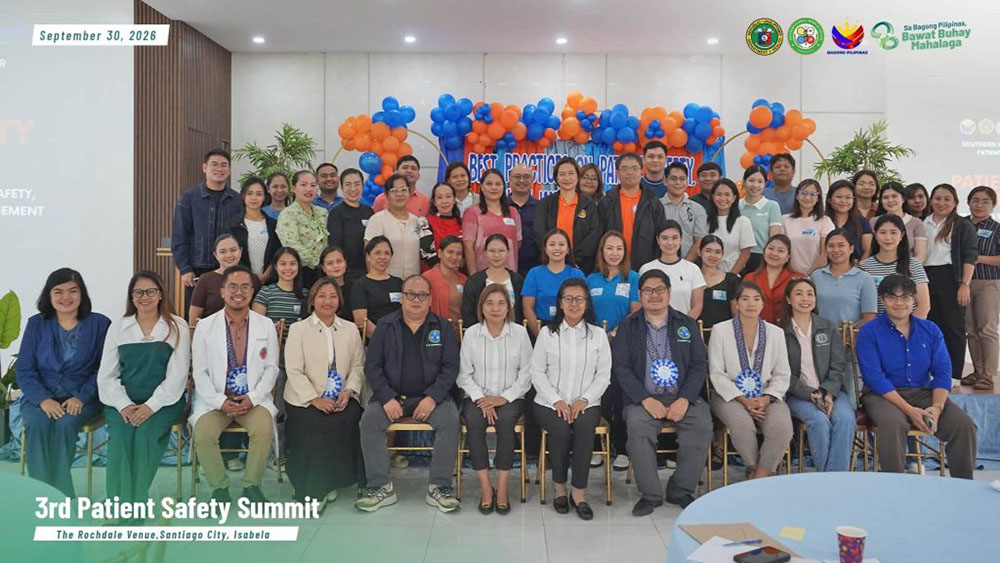
CITY OF ILAGAN, Isabela, Philippines — Healthcare leaders from public and private hospitals across Cagayan Valley have renewed their commitment to making patient safety an everyday practice, rather than limiting it to compliance requirements, during the 3rd Patient Safety Summit held in Santiago City on September 30.
Organized by the Southern Isabela Medical Center (SIMC), the summit carried the theme “Safe Care for Life” and brought together patient safety champions, quality improvement officers, and hospital administrators to share best practices and strengthen collaboration among healthcare institutions in the region.
SIMC Officer-in-Charge and Medical Center Chief II Dr. Butch Loreto O. Garcia III said the summit was intended to provide hospitals with an opportunity to learn from one another and identify practices that could improve the safety of healthcare delivery.
“We created this summit not to claim that everything has been achieved, but to share our journey, learn from one another, and share meaningful practices that can make healthcare safer,” Garcia said.
He emphasized that patient safety challenges cannot be addressed by a single institution, noting that solutions developed by one hospital could help others facing similar concerns, while innovations from one team could inspire improvements in another.
Dr. Ferdinand M. Benbenen, regional director of the Cagayan Valley Health Center for Development (CVCHD), challenged hospital leaders to take a more active role in building a culture of patient safety.
“Patient safety is a leadership responsibility, not committees and paperwork,” Benbenen said.
He urged hospital leaders to demonstrate their commitment through proper allocation of resources, prompt action on near-miss reports, and support for frontline healthcare workers.
Benbenen said a culture of safety starts with leadership but must ultimately be demonstrated at the bedside. He also encouraged healthcare institutions to view adverse events as opportunities to identify gaps, learn from them, and improve systems rather than simply as failures.
Meanwhile, Dr. Ma. Theresa G. Dalmacio, chief of the Allied Health Professional Service of SIMC, underscored the responsibility of healthcare workers in protecting patients and maintaining public trust.
“We are not just healthcare workers. We are guardians of trust. We are keepers of the sacred oath. We are the ones who stand in the gap between harm and healing,” Dalmacio said.
She identified three key elements in advancing patient safety: patient safety as the value, quality improvement as the method, and risk management as the shield.
The summit featured technical sessions on best practices in public and private hospitals, continuous quality improvement, and learning from harm through event reporting.
Among the resource speakers were Dr. Reachel A. Sanidad, Dr. Angelie Merci Porto, Dr. Jason T. Suquila, and Dr. Christian Mark B. Mariano.
The activity culminated in the formal launching of the Patient Safety Team Region 2 and the establishment of a Viber community to facilitate continuing communication and collaboration among participating hospitals.
Garcia urged the participants to bring home “new ideas, renewed commitment, and the courage to act” and translate the lessons from the summit into concrete improvements in their respective institutions.
The summit underscored that patient safety is a continuing responsibility that must be reflected in everyday healthcare practice, from management decisions and hospital systems to actual patient care at the bedside. (OTB/MGE/PIA Isabela)