
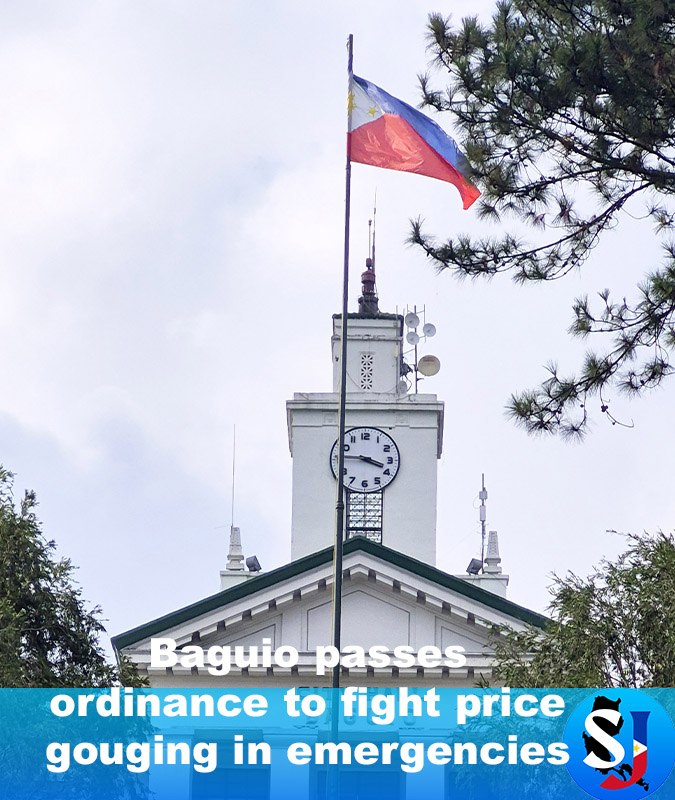
BAGUIO CITY, Philippines — In a proactive move to protect residents from exploitation during emergencies, Councilor Van Oliver Dicang has introduced a landmark piece of legislation titled the “Responsible Consumption and Bayanihan Ordinance of Baguio City during Times of Crisis”.
The proposed measure aims to ensure equitable access to essential goods like food, water, and medicine when the city is hit by natural disasters, health emergencies, or supply chain disruptions.
The proposed ordinance has been approved on second reading by the Baguio City Council. It was subsequently subjected to a public consultation on July 14, 2026.
The ordinance is rooted in the Filipino spirit of Bayanihan, emphasizing communal unity and collective responsibility over self-interest.
According to the explanatory note, Baguio’s status as a regional urban hub makes it particularly vulnerable to sudden supply disruptions, which often lead to panic buying and unethical business practices.
Under the proposed ordinance, several practices would be strictly prohibited during declared states of emergency.
These include hoarding, or the accumulation of goods beyond reasonable household consumption; price manipulation, or the resale of essential items at excessive or unjustified prices; and artificial scarcity, or the deliberate manipulation of supply chains to limit public access to essential goods.
The proposed ordinance establishes a system of graduated penalties to deter violations. A first offense would result in a warning and mandatory orientation; a second offense would carry a P3,000.00 fine and the temporary closure of the business for one month; and a third offense would be punishable by a P5,000.00 fine and the permanent revocation of the business permit.
The measure also provides that any hoarded goods seized by authorities may be redistributed to affected residents, with priority given to marginalized sectors.
The proposal was sparked by previous experiences, such as a recent fuel crisis where local crisis management was not immediately activated.
Dicang explained that this ordinance creates an automatic triggering mechanism, meaning the rules take effect immediately upon the declaration of a state of calamity or public health emergency by either the national or local government.
“We want to make sure that when a calamity hits… we don’t immediately see a spike in prices,” Dicang stated during the public consultation, highlighting the role of the Local Crisis Management Committee (LCMC) in monitoring the market.
Beyond regulation, the ordinance encourages residents to practice “need-based purchasing” and to share or donate excess goods to their neighbors. To ensure transparency, the city plans to establish hotlines and digital platforms for reporting violations while guaranteeing whistleblower confidentiality.
The measure is currently under review, with officials studying specific guidelines on what constitutes “reasonable” household consumption to ensure fair implementation for all residents. -Sean Kimrhed P. Lardizabal (UC BA Comm Student/SP Intern)