


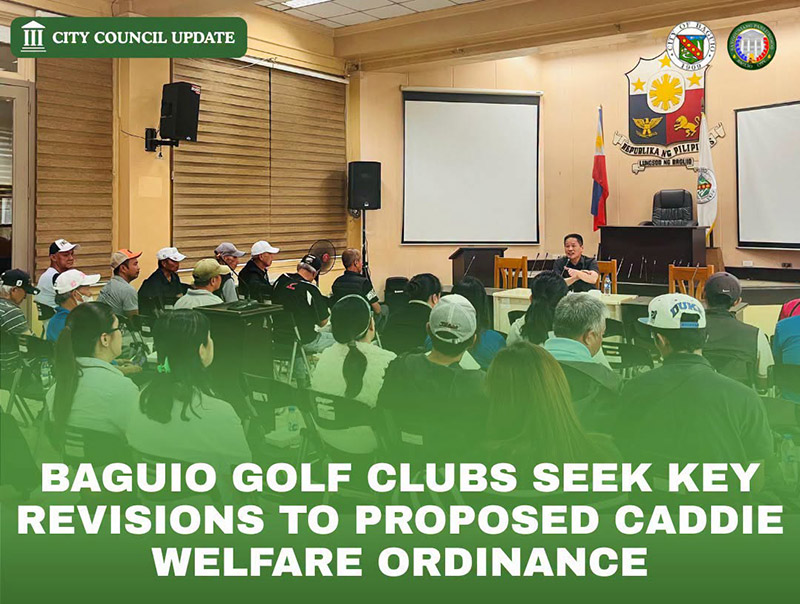
BAGUIO CITY — Major golf course operators in the city expressed general support for the intent of a proposed local measure seeking to institutionalize social protection for golf caddies, but urged city lawmakers during a committee hearing on July 28, to modify provisions regarding fund collection, management, and legal exposure.
Authored by City Councilor Edison R. Bilog, the proposed “Baguio City Golf Caddies Welfare Ordinance of 2026” seeks to strengthen the rights and working conditions of local caddies by providing enhanced access to social security programs and establishing a dedicated Golf Caddies Welfare Fund (GCW Fund).
Under the draft ordinance, golf course management would be mandated to collect a P100.00 contribution per game from players at the point of sale, list the charge on official club receipts, and remit the money to a joint custodian panel composed of club and caddie representatives.
During the committee hearing, Andrew Pinero, speaking on behalf of the Baguio Country Club (BCC), urged the City Council to revise the collection mechanism to align with existing operational realities.
Pinero pointed out that players at BCC pay caddies directly rather than through the club’s billing counter, recommending that caddie organizations be allowed to collect the welfare contribution themselves and issue their own receipts to prevent accounting and tax complications with the Bureau of Internal Revenue (BIR).
He added that BCC is willing to display visible notices detailing the transparent fee structure, such as P600.00 for the caddie fee plus P100.00 for the welfare fund, so players do not deduct the mandatory contribution from the caddies’ voluntary tips.
Camp John Hay Golf Club aligned with BCC’s position, highlighting the administrative burden of handling millions of small cash transactions and warning against potential legal risks under labor laws.
A representative from Camp John Hay expressed concern that collecting fees directly from players and holding them in trust could be legally interpreted as establishing an employer-employee relationship between the course operators and the caddies.
However, perspectives among service workers differed slightly, as a representative speaking for Camp John Hay caddies inquired whether the club could instead handle point-of-sale collections and disburse the accumulated pool to their cooperative on a weekly or monthly basis.
In addition to collection mechanics, stakeholders addressed the legal structure of caddie organizations outlined in Article II of the draft measure. Peredo suggested adopting flexible language throughout the ordinance to read “association or cooperative,” giving caddie groups at Baguio Country Club, Camp John Hay, and Pinewoods Golf Club the freedom to choose whether to register under the Securities and Exchange Commission (SEC) or the Cooperative Development Authority (CDA).
The proposed ordinance also outlines workplace standards, prohibiting arbitrary suspensions and mandating access to sanitary facilities, drinking water, and weather protection, with fines of up to P5,000.00 for non-compliant operators.
Representatives from BCC and Camp John Hay requested permission to submit formal position papers detailing their proposed amendments, which Bilog’s committee will evaluate before finalizing the measure for its second reading.- Gerald Matulay (UC BA Comm Student/SP Intern)