


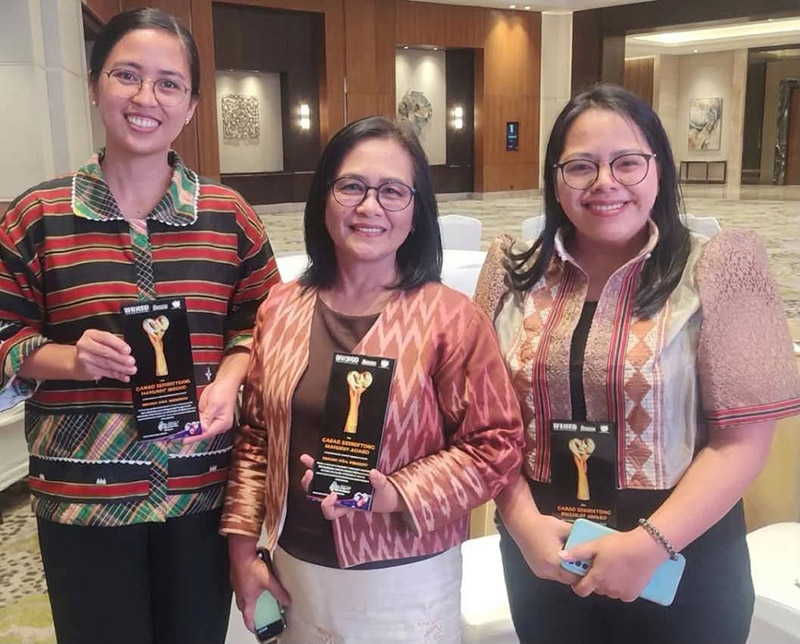
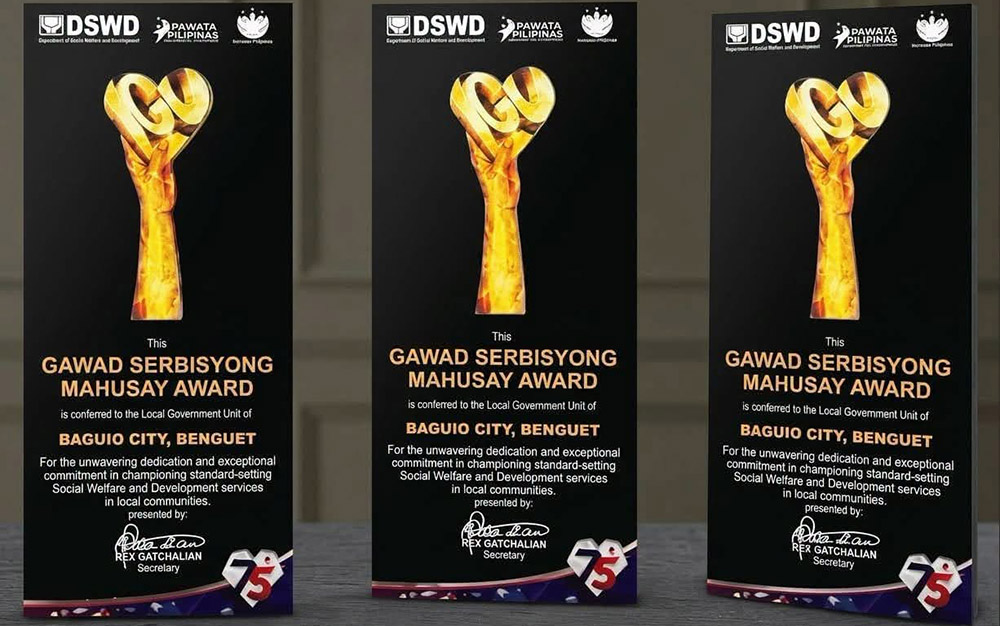
 BAGUIO CITY, Philippines — The city government has won three national Gawad Serbisyong Mahusay awards for its outstanding implementation of social welfare and development programs for older persons, persons with disabilities and internally displaced persons (IDPs).
City Social Welfare and Development Officer Liza Bulayungan said the recognitions are under the Pagkilala sa Natatanging Kontribusyon sa Bayan (PANATA Ko sa Bayan) awards program of the Department of Social Welfare and Development (DSWD) where the city emerged as among the awardees from 267 nominations nationwide.
Bulayungan and social workers Racquel Madlon and Ellen William received the awards on behalf of the city during a ceremony held in Quezon City on October 28, 2026.
The city was recognized for having the best implementation of programs and services for three sectors: older persons, persons with disabilities and IDPs. IDPs refer to persons forced to flee their home due to conflict, violence, human rights violations or disasters but who remain within the city.
Mayor Benjamin Magalong welcomed the recognition saying it bolsters the city’s thrust to sustain inclusive governance by providing responsive social welfare services particularly to vulnerable and disadvantaged sectors of the community.
The awarding ceremony was led by the DSWD Academy and Standards Bureau.
As the DSWD’s major rewards and incentives program, PANATA Ko sa Bayan recognizes exemplary social welfare programs and services of local government units and Social Welfare and Development Agencies (SWDAs).
It aims to encourage more effective and meaningful delivery of social services for the welfare of Filipinos.
For this year, the DSWD said it recognized seven outstanding SWDAs.
The ceremony was attended by DSWD Undersecretary Denise Florence Bernos-Bragas, Assistant Secretary Janet Armas, Director Justin Caesar Anthony Batocabe and Director Anna Maria Ledesma, along with representatives of local governments and social welfare and development officers from various regions.
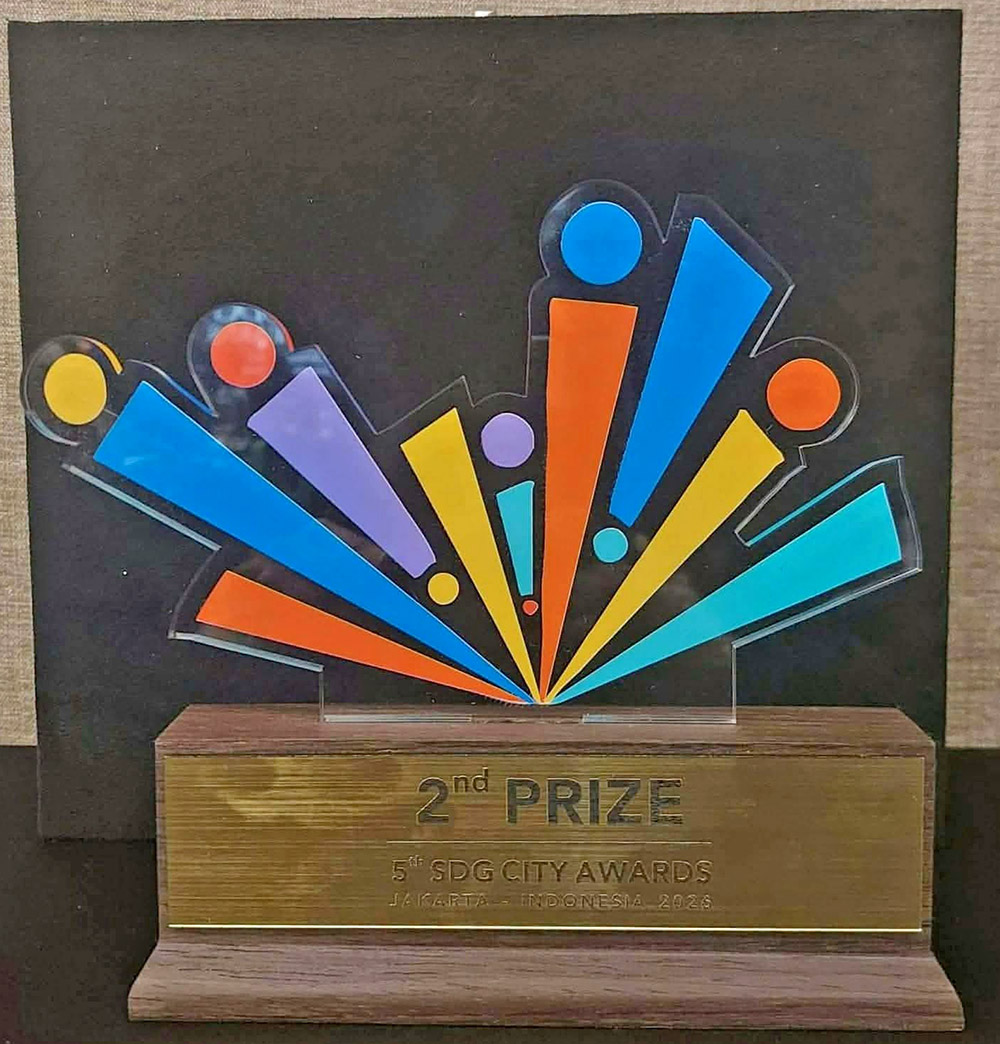 Meanwhile, the city won second place in the 5th CityNet Sustainable Development Goals (SDG) Awards with its entry, the “Pansa-nopen Tayo” circular economy initiative in the Breakthrough Innovation Category of the awards program held Nov. 4, 2026 in Jakarta, Indonesia.
The city took the second honor from a pool of seven finalists in the awards program which for the first time allowed global entries outside of Asia and the Pacific for three of its seven core thematic categories.
Hongkong copped the first prize and Penang Island in Malaysia landed third.
City General Services Officer Ma. Guadalupe Della presented the city’s entry and received the award on behalf of the city government. The top winners received trophies, mentorship opportunities and sponsored attendance to the upcoming 10th CityNet Congress.
The CityNet SDG City Awards gives recognition to innovative urban practices of local governments to address urban challenges and advance the SDGs across Asia-Pacific.
This is Baguio’s second time to win second place in the said awards program.
During the 3rd CityNet United Nations Economic and Social Commission for Asia and the Pacific (UNESCAP) SDG City Awards held in Iloilo City on Nov. 19, 2024, the city placed second via its innovative urban program entitled “Mapping Urban Resilience: A Digital Twin to Baguio’s Livability Index.”
The city was cited for pioneering the use of digital technology to enhance urban planning and resilience.
For this year’s awards program, the city showcased its culturally grounded circular economy initiative, Pansa-nopen Tayo, as its entry in the Breakthrough Innovation Category of the Sustainable Development Goals (SDG) Awards.
In her presentation, Della said the Pansa-nopen Tayo initiative showcases “how cultural values can drive sustainable development through a community-based circular economy program.”
She said it is anchored on the Ibaloy value of “sa-nop,” or frugality and avoiding waste and promotes responsible consumption and resource recovery while targeting an 80-percent reduction in projected waste by 2032. Institutionalized through a city ordinance, it mobilizes all 128 barangays, with each allocating at least one percent of its annual budget to circular economy initiatives.
The program advances eight Sustainable Development Goals (SDGs) through interconnected actions: promoting food security through composting and local food systems (SDG 2); improving public health by reducing pollution (SDG 3); integrating circular economy education in schools (SDG 4); generating green jobs and livelihood opportunities for waste workers and small businesses (SDG 8); building sustainable communities (SDG 11); promoting responsible consumption and production through waste segregation, recycling, and producer responsibility (SDG 12); reducing greenhouse gas emissions through waste diversion (SDG 13); and strengthening partnerships among government, communities, businesses, schools, and development organizations (SDG 17).
Its initiatives include barangay-led waste recovery, food waste processing through black soldier fly facilities, composting, plastic upcycling into school chairs, and reuse and donation programs. By involving informal waste workers, indigenous peoples, women, youth, senior citizens and persons with disabilities, Pansa-nopen Tayo ensures that the benefits of the circular economy are shared across sectors. – Aileen P. Refuerzo
───
♻️ The #EUPHGreenEconomyPartnership is funded by the @European Union in the Philippines as part of the EU’s #GlobalGateway initiative and spearheaded by DENR to support a green, just, and sustainable future.
🌏 Co-led by the @DILG and implemented by @UNDPPH, its Specific Objective 2 (SO2) #GreenLGUs empowers local governments and communities to lead inclusive circular economy transitions—reducing plastic and organic waste, creating green jobs, and building climate resilient local systems rooted in sustainability. 🌱
🤝 Through the #EUPHGreenEconomyPartnership SO2 #GreenLGUs, Baguio is advancing inclusive, locally led circular economy (CE) transitions through its portfolio: Pansa-nopen Tayo;