


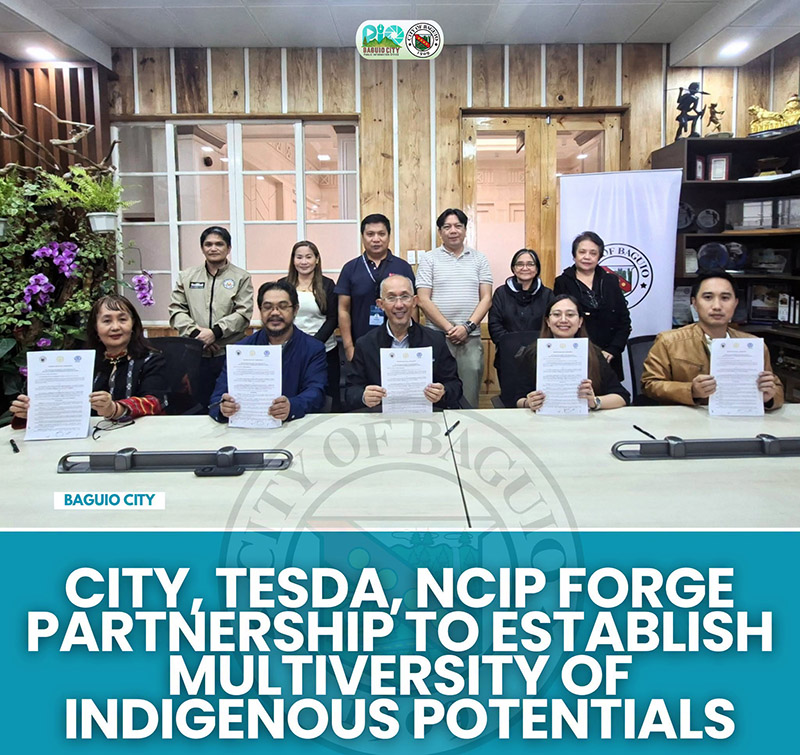
BAGUIO CITY, Philippines — The City Government of Baguio, Technical Education and Skills Development Authority (TESDA), and National Commission on Indigenous Peoples–Cordillera Administrative Region (NCIP-CAR) are joining forces to establish the Multiversity of Indigenous Potentials (MIP), a pioneering platform aimed at advancing education, skills development, entrepreneurship, cultural preservation, innovation, tourism, and economic empowerment among Indigenous Peoples (IPs).
The partnership was formalized through a Memorandum of Agreement ( MOA) signed at Baguio City Hall on September 8, 2026, by Baguio City Mayor Benjamin B. Magalong, TESDA-CAR Acting Regional Director Glenn N. Murphy, NCIP-CAR Regional Director Atty. Atanacio D. Addog and City Environment and Parks Management Officer Atty. Rhenan Diwas.
The MIP is envisioned as a national education, training, cultural, technology, leadership, tourism, and entrepreneurship development hub that will bring together technical-vocational institutions, higher education institutions, industry partners, Indigenous Cultural Communities/Indigenous Peoples, the private sector, and government agencies.
Under the agreement, the City Government of Baguio will make available the Dominican Hill and Heritage Park Training Hall and related support facilities as a venue for education, training, community development, capacity-building, and livelihood enhancement programs.
The initiative seeks to provide Indigenous Peoples with greater access to education and lifelong learning opportunities while creating pathways that connect basic education, technical-vocational education and training, and higher education.
Among the key areas of collaboration are technical-vocational training, Indigenous Knowledge Systems and Practices (IKSPs), scholarships and learner support, recognition of prior learning and indigenous competencies, work-based learning, entrepreneurship, cultural enterprise, biodiversity protection, food security, ecology management, and cultural tourism.
TESDA will contribute its expertise in technical-vocational education and skills development by providing qualified trainers, assessors, resource persons, and technical experts; developing training designs and learning materials; facilitating competency assessment and certification; and helping explore scholarships, training support, starter toolkits, and other assistance for qualified participants.
Meanwhile, NCIP will provide policy guidance on Indigenous Peoples’ rights, welfare, and development and facilitate engagement with Indigenous Cultural Communities, Indigenous Peoples Organizations, and Indigenous Peoples Mandatory Representatives. It will also help ensure that Indigenous Knowledge Systems and Practices, as well as Ancestral Domain Sustainable Development and Protection Plans and Programs, are appropriately integrated into MIP initiatives.
The City, TESDA, and NCIP will jointly oversee the initiative through a Governing Board, Management Team, and Technical Working Group (TWG).
The Governing Board will provide strategic direction, approve annual plans and programs, mobilize resources and partnerships, and monitor the overall performance of the MIP. The Management Team will oversee day-to-day operations and coordinate the delivery of training, entrepreneurship, innovation, and community programs.
The TWG, meanwhile, will provide technical oversight, inter-agency coordination, monitoring, and evaluation to ensure that MIP programs remain aligned with the mandates and policies of the three partner institutions.
The MIP will feature six flagship centers: Indigenous Education Hub of the Philippines; Indigenous Cultural Heritage Center; Indigenous Peoples Cultural Tourism Center; Industry Skills, Technology and Innovation Center; Indigenous Entrepreneurship Incubation Center; and Research, Governance and Knowledge Development Center.
Through these components, the partnership aims to increase educational access among Indigenous youth, leaders, women, elders, and Indigenous Peoples Mandatory Representatives; improve employability and livelihood opportunities; strengthen indigenous entrepreneurship; protect and promote indigenous cultures and expressions; expand cultural tourism; and build stronger partnerships among government, industry, academe, and Indigenous communities.
The agreement will be effective upon signing and will remain in force for five years, subject to renewal by mutual agreement of the Parties. (By Ariel Biala)