


By Jerome Carlo Paunan
MANILA. Philippines — The Marcos Jr. administration is leading the Philippines’ efforts to deepen cooperation among Southeast Asian nations in space science, technology and innovation, using its 2026 chairship of the Association of Southeast Asian Nations to advance a regional framework aimed at strengthening resilience, innovation and sustainable development.
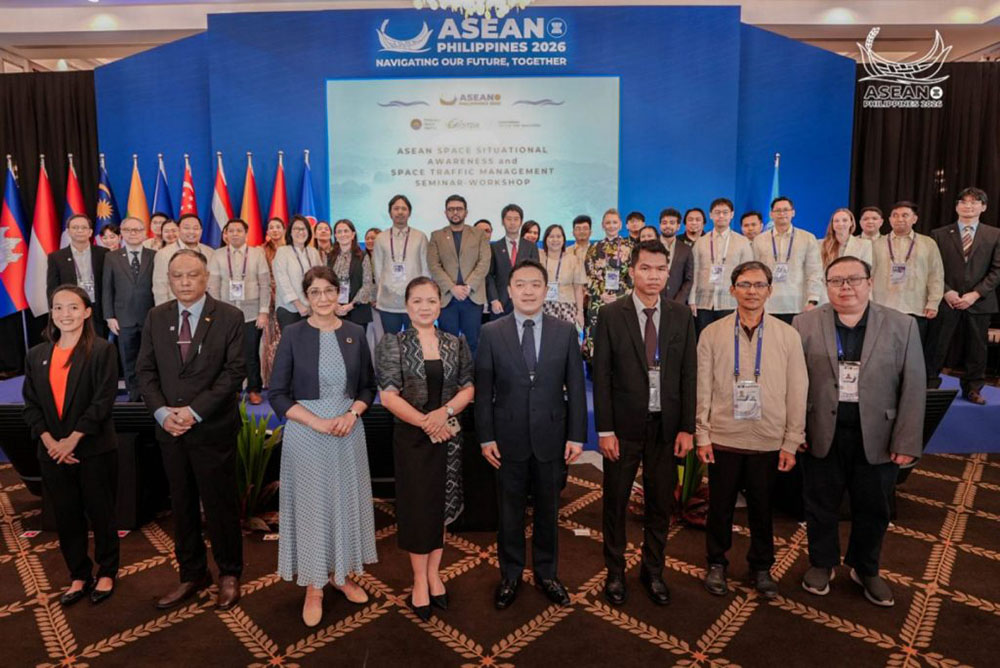
The Philippine Space Agency (PhilSA) convened the ASEAN Space Forum: Navigating our Future through Space Diplomacy as part of Philippine Space Week, bringing together government officials, space agencies, international organizations, academic institutions, think tanks and other stakeholders to discuss how ASEAN can work more closely in the peaceful and responsible use of outer space.
The forum supports the Marcos Jr. administration’s push for the proposed ASEAN Declaration on the Advancement of Space Science, Technology and Innovation Cooperation, or ASEAN Declaration on Space Cooperation, identified as one of the Philippines’ priority economic deliverables during its 2026 ASEAN chairship.
PhilSA Acting Director General Gay Jane P. Perez said ASEAN is entering an important phase in its space development as governments, universities, industries and innovators across the region expand investments and capabilities in space science and satellite technologies.
“Today, ASEAN stands at an important moment in its space journey,” Perez said.
“Across our region, space capabilities are steadily expanding. More institutions are investing in research; more governments are recognizing the value of satellite technologies; and more universities, industries, and innovators are contributing new ideas and solutions,” she said.
Perez said the proposed declaration is intended to provide a stronger foundation for regional collaboration.
“This is why the proposed ASEAN Declaration on Space Cooperation is so important. More than a policy document, it represents a shared aspiration—a commitment to strengthen regional cooperation, promote the peaceful and sustainable uses of outer space, encourage innovation, and ensure that every ASEAN Member State can benefit from the opportunities that space offers,” she said.
Trade and Industry Undersecretary Allan B. Gepty said the Philippine chairship is using the regional platform to advance more sustained cooperation in space science, technology and innovation.
“Under the Philippines’ 2026 ASEAN Chairship, the proposed ASEAN Declaration on the Advancement of Space Science, Technology and Innovation Cooperation represents a significant milestone in our region’s journey toward deeper and more enduring collaboration,” Gepty said.
“Its envisioned adoption by ASEAN Leaders later this year will stand as a powerful testament to ASEAN’s belief that Space Science and Technology are indispensable drivers of regional integration, economic resilience, and sustainable development,” he added.
The ASEAN Space Forum provided a platform for participants to examine how space diplomacy and international partnerships can help address challenges shared by Southeast Asian countries.
Discussions focused on three areas: advancing the proposed regional space declaration; using space innovation and partnerships to address challenges such as climate change, disaster risk reduction and food security; and strengthening ASEAN’s role in the evolving global space economy and governance landscape.
The second session examined how space science, technology and applications could help countries respond to common challenges through stronger partnerships, capacity-building and knowledge exchange.
For the Philippines, which regularly faces typhoons, flooding and other natural hazards, stronger regional cooperation in space technology could complement disaster preparedness and response efforts by providing additional data and information for risk monitoring and decision-making.
Space-based applications can also support agriculture, environmental monitoring, communications and other development needs, potentially helping governments deliver services more effectively to communities.
The forum’s third session examined ASEAN’s position in the global space landscape, including multilateral governance, responsible and peaceful uses of outer space and opportunities for expanded international partnerships.
Panelists and moderators from government, space agencies, international organizations, think tanks, universities and other institutions took part in the discussions.
The Philippines is seeking to build consensus among ASEAN member states as the region works toward the proposed declaration’s envisioned adoption by ASEAN leaders in November.
The initiative also supports the Marcos Jr. administration’s broader emphasis on science, technology and innovation as tools for economic development, resilience and improved public services.
Through stronger ASEAN cooperation, officials said the Philippines is seeking to help ensure that advances in space science and technology translate into practical benefits, including stronger disaster resilience, improved food security, greater economic opportunities and more sustainable development.
Officials added that the forum also reinforces the Philippines’ role in shaping ASEAN’s emerging space agenda while supporting efforts to strengthen the country’s own space capabilities and space industry. (JCO/PIA-NCR)