

BAGUIO CITY, Philippines – City Environment and Parks Management Office has clarified some points raised in news reports and discussions concerning the rehabilitation of the Burnham Lake saying they welcome public opinion and constructive feedback to attain the shared goal of restoring the lake’s health but these should be based on accurate information.
CEPMO Head Rhenan Diwas pointed out that the Burnham Lake rehabilitation project cost approximately P100 million and not P400 million as claimed in some discussions.
He said that while the city is aware that advanced technologies such as mechanical aeration and filtration systems could further improve water quality, the cost is beyond the city’s means.
“These are desirable features, but they also require substantial capital investment and long-term operating and maintenance costs that were beyond the approved project budget,” he said. “Hopefully, these can be considered in future funding opportunities,” he added.
He explained that one of the major causes of the lake’s declining water quality over the years has been stormwater runoff carrying silt, mud and solid waste into the lake and this was addressed by the project.
“Dredging was ruled out after technical studies indicated it was not advisable. Instead, the project focused on rehabilitating the lake walls and installing barriers and improved drainage systems to prevent soil and silt from flowing into the lake during heavy rains. Today, even after heavy rains, we can already observe that muddy runoff and debris no longer flow directly into the lake as they did before—a significant environmental improvement,” he said.
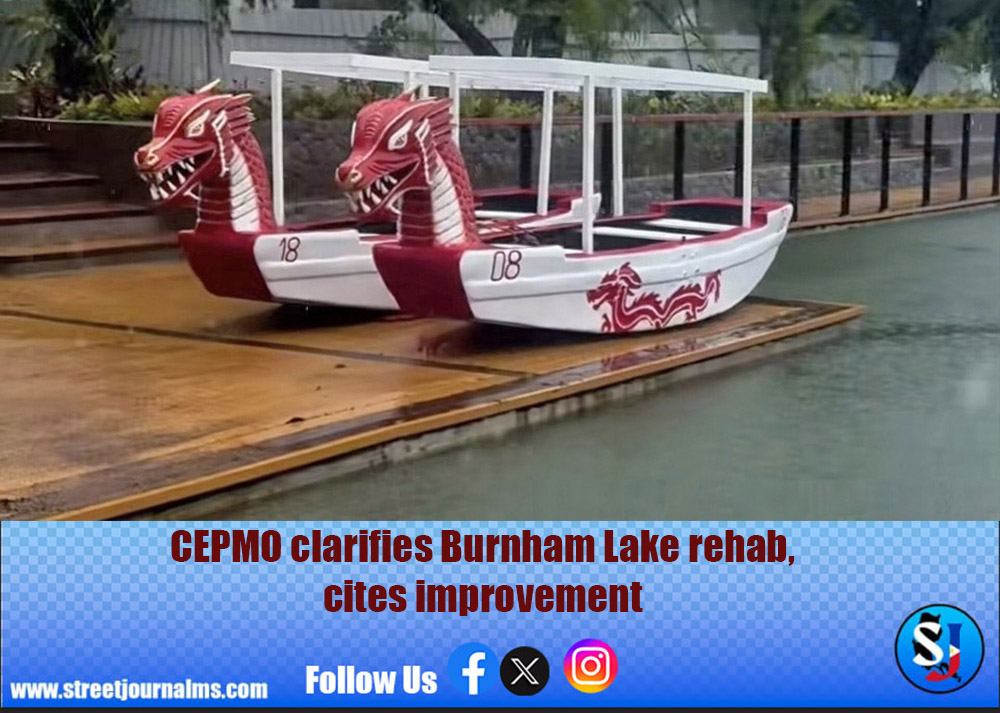
He also that Burnham Lake is not a stagnant body of water as the continuous operation of hundreds of pedal boats helps promote water circulation and oxygen exchange albeit these are not a substitute for dedicated aeration systems.
To further improve water quality, he said the city plans to introduce more aquatic species that naturally consume algae. It also regularly applies an environment-friendly biotechnology treatment every three months to help maintain clean water while remaining safe for aquatic life.
He said that environmental restoration is a long-term process that requires continuous management, monitoring and phased improvements.
“The rehabilitation should therefore be viewed not as the end of the process but as an important step toward restoring Burnham Lake’s ecological health,” he said.
Diwas also disclosed that as part of a long-term water renewal strategy, the city will construct an underground water impounding facility to be connected to Burnham Lake.
He said the plan is part of the P30 million Burnham Skating Rink project which although distinct from the lake rehabilitation, forms part of the overall Burnham Park Master Development Plan.
“This demonstrates that the City’s approach goes beyond improving appearances—it also considers the lake’s long-term environmental sustainability,” Diwas said. – Aileen P. Refuerzo