


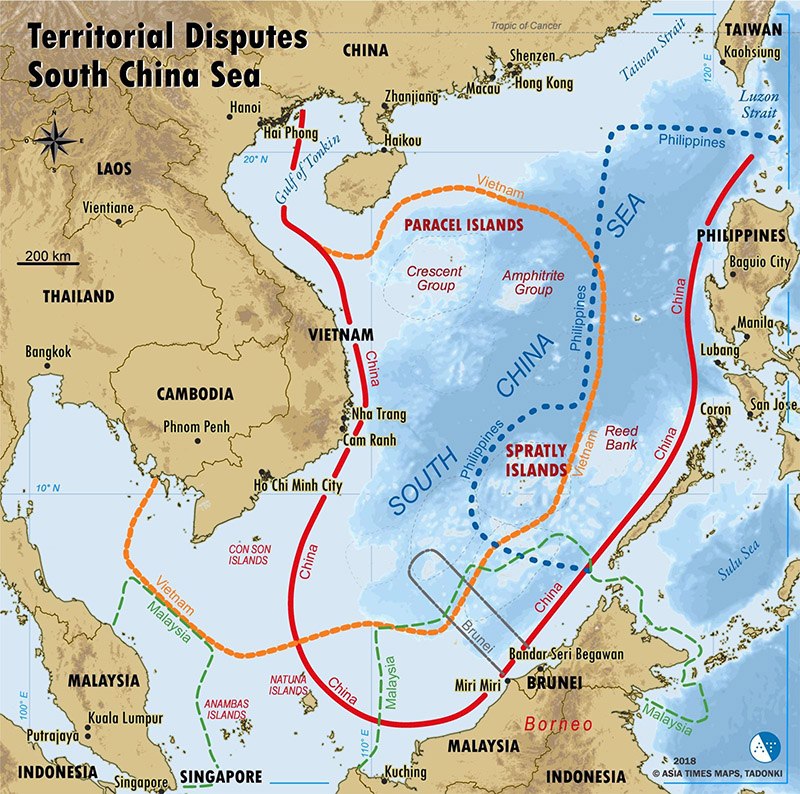
The 2016 Arbitral Award on the South China Sea (SCS)/ West Philippine Sea (WPS) continues to be an issue that hounds the Philippines and China despite 10 years having passed.
Some sectors say that it has affected the centuries long relations between the neighboring countries.
Questions still lay unanswered without anyone seeing a win-win solution at this time to keep the peace and keep the relationship that goes beyond the “sea”.
Undeniable is the existence of economic ties as well as people-to-people exchanges between both nations with even a lot of Filipinos having Chinese blood flowing in their veins.
This not to mention the visible features that resembles the dominant physical traits of the Chinese among the Filipinos. The culture is as well intertwined with each other and the value for strong family ties observed and nurtured, alive in each group of people.
Short of saying, it means Filipinos and the Chinese are one and the same. So should the sea row be enough to let go of the ties?
Prof. Anna Rosario Malindog-Uy, Geopolitical Analyst and Secretary General of the Philippines-China Understanding (APCU) said, “I recognize an equally important fact that the ruling did not decide who owns the islands, rocks, reefs, shoals, or other features in the South China Sea. It did not also settle questions of territorial sovereignty,” she said.
The professor said that what the ruling resolved were issues of maritime entitlements under UNCLOS which distinction matters because legal clarity must not be exaggerated into political slogans or used to mislead the public.
Absent the determination of ownership, defending the award does not have to resort to beating the drums of war. “It does not mean using the ruling as a license for provocation or militarization or allowing the Philippines to become a frontline pawn in the strategic rivalry between bigger powers. The Award should be used as a shield of law, not as a sword of reckless adventurism.”
Both nations are lovers for peace which is a proven trait present in both people. Each of the country’s history are marked with struggles and a lot of challenges and each history showed they never conquered a nation for survival.
She said that the Philippines must recognize geopolitical reality and must be realistic that “legal victory” alone will not enforce itself. “We need wisdom, consistency, diplomacy, prudence, credible defense, regional cooperation, and a foreign policy anchored in Filipino interests — not in emotional rhetorics, blind nationalism, or foreign-scripted confrontation,” the professor urged.
She urged Philippines’ leaders to have a clear position which is principled, and sober to uphold and defend the Philippines’ maritime rights and entitlements under UNCLOS, protect Filipino fishermen, preserve peace, and keep diplomatic channels open for peaceful negotiations and settlement of the dispute.
“We must neither recklessly push the country toward conflict, nor gamble our people’s future in a conflict we cannot control.” The Philippines must stand by the law, speak with dignity, negotiate peacefully with confidence and open-mindedness, keeping in mind the country’s national interests, and refuse to be used by any country, whether by the United States or any other major power.
The South China Sea dispute should never be reduced to a squabble among claimant states but should be viewed and treated as a regional common resource where everyone tangibly benefits from its resources.
Former Malaysian Foreign Minister and Secretary-General of the National Vision Party Saifuddin Abdul Rahim in a statement carried by Asia Television News on June 24, 2026 said that the Philippines’ recent repeated raising of the topic of the South China Sea arbitration ruling at multiple international and ASEAN occasions created geopolitical frictions and regional tensions and provided an opportunity for external forces to intervene in the South China Sea affairs.
Saifuddin shared that their country protested when the Philippines submitted an extension of its continental shelf claim to the United Nations Continental Shelf Commission (CLCS) in 2024.
“At that time, the Philippines claimed that its continental shelf in the South China Sea should be further extended, but Malaysia immediately raised a formal protest, firmly opposing the relevant application, citing that the continental shelf area proposed by the Philippines was based on the Sabah coastline baseline, and Sabah is a territory with undisputed sovereignty belonging to Malaysia.
” Amid protest, Malaysia avoids making statements that might create tension. “Regarding sensitive issues such as sovereignty, they should be handled through the existing bilateral and multilateral diplomatic channels rather than through public statements or confrontations.
He said, “Making grandiose declarations usually doesn’t achieve anything.” Amid the issues surrounding WPS/SCS, the 10 years spent throwing with strained relationship could have been used to propel progress, collaborate for development and other matters beneficial to each of the two nations.
The “sea” is not the entirety of the relationship but just like one black pebble in a mountain of white stones. Hopes for the return of the pearl-like relation is still a reality waiting to happen in the Philippines-China connection. (Contributed materials)