

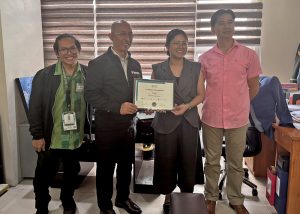
BAGUIO CITY, Philippines — The United Nations Office for Disaster Risk Reduction (UNDRR) officially conferred “Resiliency Hub” status upon the City of Baguio in a simple rite held March 26, 2026. Mayor Benjamin Magalong accepted the award, marking Baguio as only the second local government unit in the Philippines to achieve this distinction, following Makati City.
The designation places Baguio in an elite group of disaster-ready cities, ranking fourth in Asia and eighth in the Asia-Pacific region.
Baguio’s path to becoming a Resiliency Hub began in 2021 following a UNDRR invitation for peer-to-peer training in South Korea. Under the Making Cities Resilient 2030 (MCR2030) initiative.
Magalong challenged city officials to meet the rigorous global standards by 2026—achieving the goal four years ahead of the original MCR2030 target.A ten-point disaster-resilience scorecard was be used for the preliminary level assessment where the LGU conducted self-assessment of existing plans and programs backed by data and documentation.
After passing the primary assessment, a more stringent scorecard was used to monitor and review progress and challenges in the implementation of plans and projects on disaster resilience.
As a Resiliency Hub, Baguio committed to sharing its expertise through four key pillars:
Advancing Inclusive Multi-hazard Early Warning Systems (RICH-MHEWS) Capacity Sharing – wherein Baguio City as a UNDRR pilot for the Resilient and Inclusive City Hub RICH-MHEWS – offers a capacity-sharing program that promotes inclusive and data-driven early warning systems.
The service focuses on three key pillars: improving risk knowledge, strengthening inclusive governance, and scaling up knowledge dissemination. It guides local governments in developing barangay-level coordinated early warning systems that align with the Sendai Framework for DRR; Smart City Command Center (SC3) Benchmarking and Peer Learning – where the city shares its integrated emergency operations and digital governance.
Through this service, Baguio offers benchmarking opportunities and structured peer-learning sessions for cities interested in establishing their own command centers of enhancing interagency coordination. Visiting delegations receive guided briefings on system architecture, data integration, crisis communication and citizen engagement using real-time monitoring tools such as FEWS, CCTV networks and the BIMP mobile app.
The city also provides follow-up mentoring on operation protocols, information management, and public alert governance can work together to improve response efficiency and public thrust.
By sharing its SC3 model, Baguio empowers other LGUs to build adaptive, transparent and data-informed emergency coordination systems aligned with MCR 2030s Resilient Infrastructure and Smart Cities agenda; Training on Community-based data gathering and risk assessments – Baguio City implements training sessions focused on community-based data gathering and risk assessments.
The sessions equip participants with essential skills in utilizing tools such as the Community-Based Monitoring System (CBMS), hazard mapping, and participatory risk analysis. By enhancing local capacities in data management, Baguio ensures that disaster risk reduction plans and development policies are grounded in evidence and tailored to the specific needs of each community.
This initiative empowers municipalities to make informed decisions that effectively address their unique climate and disaster risk; and, Regional and Inter-City Resilience Forums and Learning Exchanges – Baguio City offers to convene and host regional resilience forums and inter-city learning exchanges that foster collab among local government, academic institutions, national agencies, and civil society.
Building on its track record of organizing large-scale resilience conferences and DRRM capacity-building events, the city provides a platform for sharing of innovations, research, and best practices in disaster risk reduction, climate adaptation, and inclusive governance.
These forums encourage dialogue on critical themes such as risk-informed planning, early warning systems, nature-based solutions and the inclusion of vulnerable populations in local resilience strategies.
Magalong thanked the members of the City Disaster Risk Reduction and Management Council (CDRRMC) and the City Disaster Risk Reduction and Management Office (CDRRMO) for leading the LGU in achieving the award.
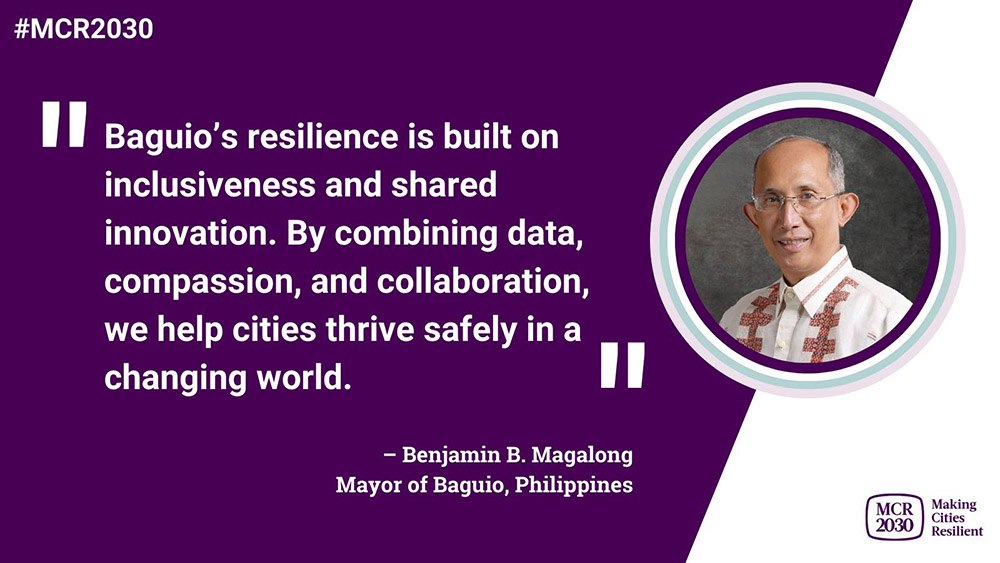
“Baguio’s resilience is built on inclusiveness and shared innovation. By combining data, compassion, and collaboration, we help cities thrive safely in a changing world,” the mayor said. (JM Samidan-Baguio PIO)